
Deep Packet & Traffic Analysis
Deep packet inspection that reads an attacker's intent
Knowing which systems are talking is useful. Understanding what they are actually doing is decisive. Immune's traffic analysis inspects network behavior in depth to expose the command-and-control channels, lateral movement, and data theft that define a ransomware attack.
Immune performs deep packet and traffic analysis to detect command-and-control beaconing, abnormal file-sharing and remote-desktop activity, and the data exfiltration behind double-extortion — the tradecraft signature-only tools routinely miss.
The attack lives in the details of the traffic
Every stage of a ransomware attack leaves a fingerprint in network traffic, if you look closely enough. When an attacker establishes remote control of a compromised system, they open a command-and-control channel that tends to beacon out at regular intervals, often disguised inside ordinary-looking web or DNS traffic. When they move laterally, they lean on protocols like server message block and remote desktop in ways that differ subtly but measurably from legitimate administration. When they prepare for double extortion, they move unusual volumes of data toward destinations the network has never sent data to before. Each of these is invisible to a defense that only checks whether traffic is allowed, and each is detectable to one that analyzes how the traffic actually behaves.
This is the job of deep packet inspection and traffic analysis. Rather than treating a connection as a simple yes-or-no question of permission, Immune examines its characteristics — timing, volume, direction, protocol behavior, and destination reputation — and asks a harder question: is this connection consistent with normal clinical operations, or is it consistent with an attack? Because Immune has already learned what normal looks like for your environment through continuous monitoring, that comparison is precise rather than guesswork.
See it in action
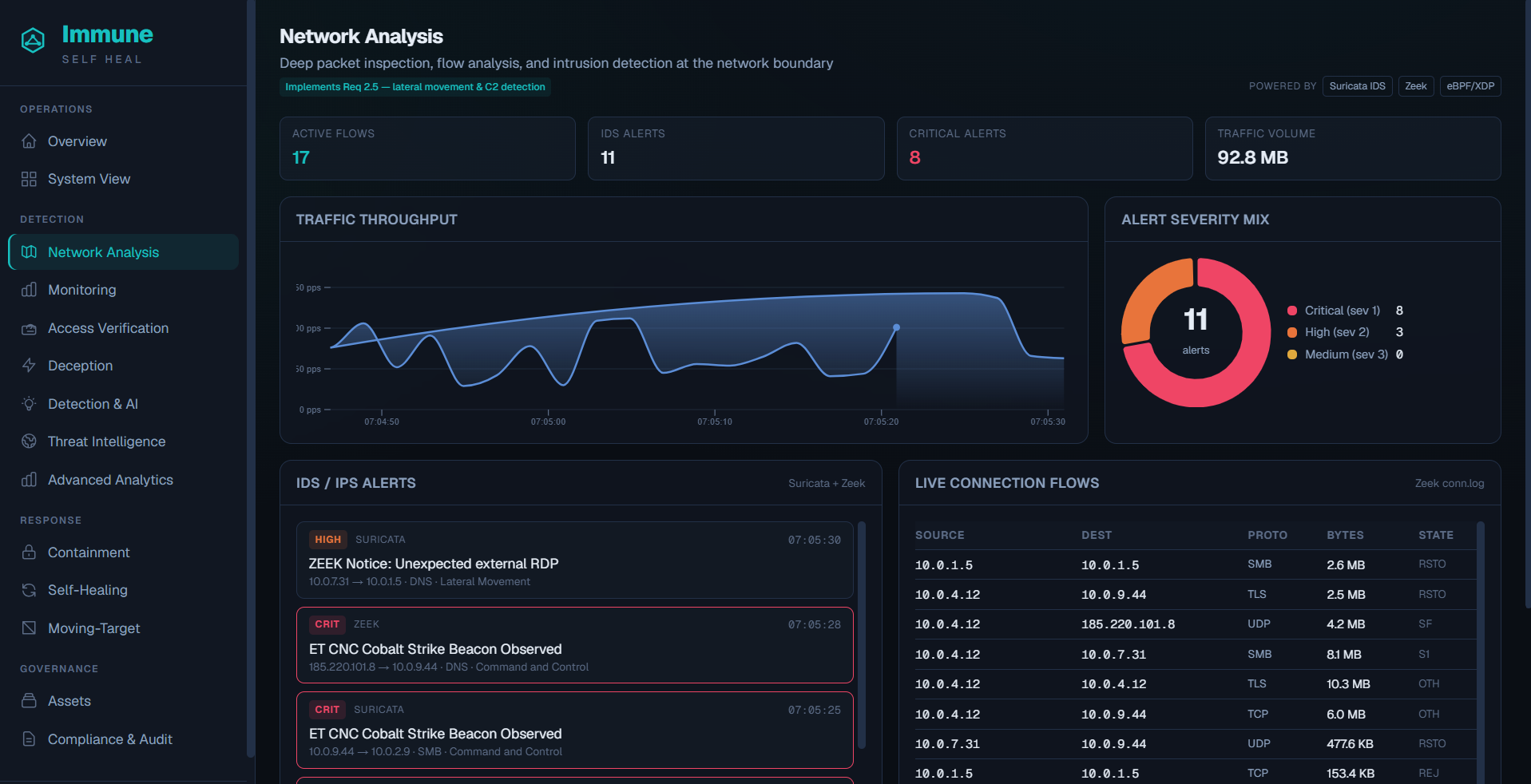
The traffic analysis console reveals command-and-control channels, lateral movement patterns, and data exfiltration in progress.
Features
What traffic analysis detects
Command-and-control beaconing
The regular, patterned call-outs of a remotely controlled system, even when hidden in common protocols.
Lateral-movement patterns
Abnormal server-message-block and remote-desktop activity that signals an attacker spreading.
Reconnaissance detection
Scanning and probing behavior as an attacker maps the network.
Data-exfiltration analysis
Volume, timing, and destination anomalies of data being stolen ahead of encryption.
Protocol-abuse detection
Legitimate protocols being used illegitimately to evade simpler defenses.
Behavioral, not just rules
Analyzes how traffic behaves, so disguised and novel channels are still exposed.
How it works
How traffic analysis works
Inspect the traffic
Immune examines the characteristics of connections in depth — timing, volume, direction, protocol behavior, and destination.
Compare to normal
Each connection is measured against the learned baseline of your environment's legitimate behavior.
Read intent
Immune asks whether a connection is consistent with clinical operations or with an attack, rather than just whether it's permitted.
Expose the tradecraft
Command-and-control, lateral movement, reconnaissance, and exfiltration are flagged as they happen.
Trigger the response
A confirmed malicious channel can immediately isolate the affected system before encryption begins.
Advantages
The advantages of deep traffic analysis
Catches the quiet middle
Reads intent from behavior, raising a confident alarm before any file is encrypted.
Disrupts double extortion
Detects exfiltration in progress, cutting the channel before the theft completes.
Sees through disguises
Behavioral analysis exposes malicious traffic hidden in normal protocols.
Covers agentless devices
Works at the network level, so it protects the devices no endpoint tool can watch.
Feeds one diagnosis
Traffic findings fuse with host, identity, and deception signals for a clear verdict.
Fast containment
A confirmed command-and-control signal can isolate the system in seconds.
Use cases
Where traffic analysis proves its value
Detecting remote control
Expose command-and-control beaconing from a compromised system.
Stopping data theft
Catch exfiltration before double-extortion leverage is established.
Tracking lateral movement
Follow an attacker's path between systems through protocol anomalies.
Uncovering hidden channels
Reveal malicious traffic tunneled inside legitimate-looking protocols.
Common questions
Deep packet inspection and traffic analysis, answered
+What is deep packet inspection?
Deep packet inspection (DPI) examines the contents and behavior of network traffic — not just where it is going, but what it is doing — to identify threats such as command-and-control communication, data exfiltration, and protocol abuse that simple traffic logging would miss.
+How do you detect command-and-control traffic?
Command-and-control channels have recognizable patterns: regular beaconing intervals, connections to unusual destinations, and traffic that hides inside otherwise-normal protocols. Immune analyzes these behaviors and flags the beaconing and anomalies that indicate an attacker is remotely controlling a compromised system.
+How is traffic analysis different from network monitoring?
Network monitoring gives you the map of what is connecting to what. Traffic analysis goes deeper, inspecting the behavior and characteristics of those connections to determine intent — distinguishing a routine file transfer from data theft, or normal remote administration from an attacker moving laterally.
+Can Immune detect data exfiltration?
Yes. Immune watches for the volume, destination, and timing patterns typical of data being stolen, so double-extortion attempts — where attackers steal data before encrypting it — can be caught and disrupted while they are still in progress.
+Does it work when attackers hide in normal protocols?
Yes. Attackers often tunnel malicious traffic inside common protocols to blend in. Immune analyzes behavior rather than only ports and destinations, so protocol abuse and disguised command channels are still exposed.
+When in an attack does traffic analysis help most?
It is most valuable in the long, quiet middle of an attack — after intrusion, before encryption — when the attacker is exploring and positioning and their network behavior is most distinctive. Catching them there means containing the attack before any file is encrypted.
Explore the platform
Related capabilities
Expose the traffic that gives an attacker away
Book a demo and see how Immune reads command-and-control, lateral movement, and exfiltration straight from network behavior.