
Intrusion Detection & Prevention
Intrusion detection and prevention built for hospital networks
An intrusion detection system is the tripwire that catches an attacker inside your network. Immune delivers IDS and IPS tuned specifically to ransomware tradecraft, combining known-threat matching with behavioral analysis so that both familiar and never-seen-before attacks are caught in real time.
Immune's intrusion detection blends signature matching for known threats with behavioral analysis for novel ones — then can act to prevent an intrusion from progressing, with patient safety always gated behind human approval.
Why hospitals need intrusion detection built for their reality
Intrusion detection is one of the oldest ideas in security, and also one of the most misunderstood. Many hospitals run an intrusion detection system that was configured years ago, tuned for a generic enterprise, and left to generate alerts that no one has time to read. That is not detection; it is noise. Effective intrusion detection in a modern hospital has to do three things at once: recognize the known attacks instantly, notice the unknown ones that have no signature yet, and do both without burying the security team under false alarms.
Immune approaches intrusion detection as a purpose-built capability rather than a checkbox. It is tuned to the specific behaviors that make up a ransomware campaign — the reconnaissance, the lateral movement, the credential abuse, and the staging that precede encryption — and it is designed for the dense, device-heavy networks that hospitals actually run. The result is detection that is both sensitive and precise: it catches the attacks that matter and stays quiet about the ordinary clinical traffic that would trip a poorly tuned system.
See it in action
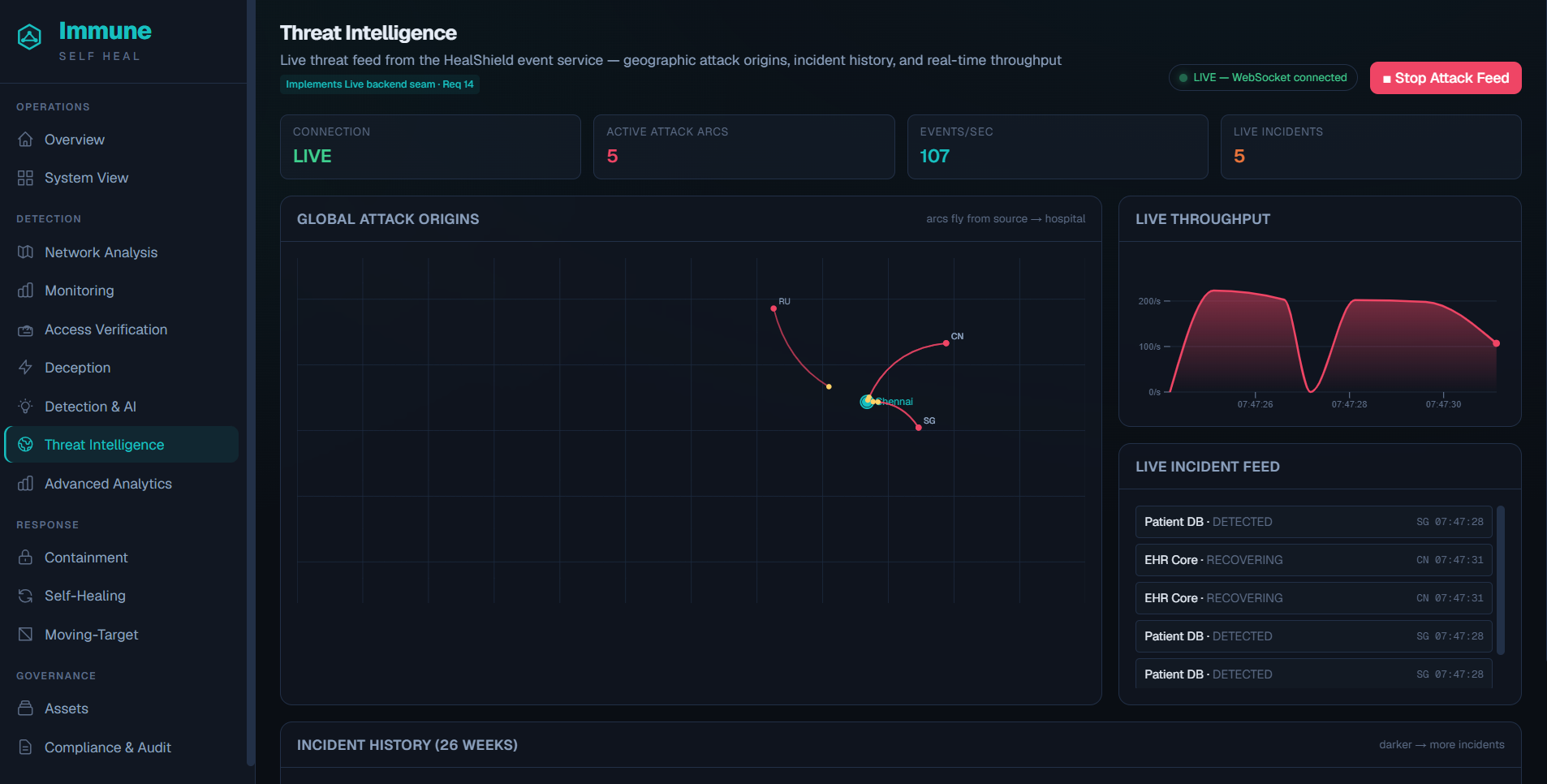
The IDS/IPS console shows live alert classification, signature hits, and behavioral anomalies — all fused into one actionable stream.
Features
What intrusion detection provides
Signature-based detection
Matches activity against a continuously updated library of known attack patterns and indicators.
Behavioral detection
Flags activity that departs from your environment's baseline, catching zero-day attacks.
Ransomware-tuned rules
Focused on the tradecraft of real hospital attacks, not generic enterprise rules.
Real-time prevention
Acts on high-confidence intrusions to block the source and isolate affected systems.
Network + host coverage
Detects intrusions on the wire and on hosts, including agentless medical devices.
Correlated alerts
Signals join host, identity, and deception data so subtle attacks still surface.
How it works
How intrusion detection and prevention works
Match the known
A fast signature pass catches known ransomware families and tools the instant they appear.
Flag the unknown
Behavioral analysis identifies activity that deviates from normal, surfacing novel and zero-day attacks.
Correlate the signals
Detections are combined with host, identity, and deception data to form a confident picture.
Decide the response
High-confidence, low-risk intrusions are acted on automatically; care-impacting actions await human approval.
Prevent progression
The malicious source is blocked and affected systems isolated before the intrusion can advance.
Advantages
The advantages of Immune's IDS/IPS
Known and unknown covered
Signatures give certainty about the known; behavior covers the unknown.
Ransomware-focused
Tuned to real hospital attack tradecraft, not generic rules.
Low false-positive noise
Baselining and correlation keep alerts meaningful and actionable.
Detection meets response
Intrusions feed containment and self-healing, not just a ticket queue.
Covers agentless devices
Network-level detection reaches the systems endpoint tools can't.
Evasion-resistant
An attack that changes its code still has to behave like an attack.
Use cases
Where intrusion detection matters
Early-stage intrusion
Catch an attacker's first moves inside the network before they escalate.
Zero-day ransomware
Surface novel strains that have no signature through their behavior.
Credential-based intrusion
Combined with access verification, flag valid-login attacks that evade signatures.
Medical-device intrusion
Detect attacks against connected devices at the network level.
Common questions
Intrusion detection and prevention, answered
+What is an intrusion detection system in healthcare?
An intrusion detection system (IDS) monitors network and system activity to identify signs of a cyberattack, alerting security teams to malicious behavior. An intrusion prevention system (IPS) goes a step further and actively blocks it. In healthcare, IDS/IPS is critical for spotting the network intrusions that precede a ransomware event.
+What is the difference between signature-based and behavioral intrusion detection?
Signature-based detection matches activity against known attack patterns — fast and precise for threats seen before. Behavioral detection flags activity that deviates from normal, catching novel and zero-day attacks that have no signature yet. Immune uses both, so known threats are caught instantly and unknown ones still surface.
+Can intrusion detection catch attacks that use valid credentials?
Signature-based detection alone often cannot, because valid-credential activity looks legitimate. Immune pairs intrusion detection with continuous access verification and behavioral analysis, so an attacker using stolen credentials still triggers an alert when their behavior departs from the norm.
+Does Immune prevent intrusions or only detect them?
Both. Immune detects intrusions in real time and, when confidence is high, acts to prevent them from progressing — blocking the source and isolating affected systems, with patient-care-impacting actions gated behind human approval.
+Will intrusion detection flood us with false positives?
Immune is engineered against alert fatigue. Behavioral baselining tuned to your environment and correlation across multiple signals keep alerts meaningful, so the security team sees the attacks that matter rather than a wall of noise.
+Does it protect devices that can't run an agent?
Yes. Because detection operates at the network level as well as the host, it extends to the medical devices and legacy systems that endpoint tools cannot cover.
Explore the platform
Related capabilities
Catch intrusions before they become an outage
Book a demo and see Immune's signature and behavioral intrusion detection catch both known and novel attacks in real time.