
Detection & AI Reasoning
AI ransomware detection that catches what signatures can't
The most dangerous ransomware is the kind no one has seen before. Immune's detection engine combines signature matching for known threats with AI-driven behavioral analysis for unknown ones, then fuses every signal into a single, explainable verdict your team can act on in seconds.
Immune detects ransomware by behavior, not just by signature — fusing host, network, identity, and deception signals with AI reasoning to catch zero-day and living-off-the-land attacks, and explaining each verdict in plain language.
Why signature-only detection is no longer enough
For years, security detection worked like a bouncer with a book of known troublemakers: match the face to the book, deny entry. Signature-based detection is exactly that, and for known threats it is fast and reliable. But ransomware operators long ago learned to change their faces. They alter their code so it matches no known signature, they buy or build custom tooling, and increasingly they do not bring malware at all — they log in with stolen credentials and abuse the legitimate administrative tools already present in your environment. Against this, a defense that can only recognize what it has seen before is perpetually one step behind.
The answer is to detect by behavior. However an attacker disguises their code, they cannot disguise what they are trying to do. Ransomware still has to spread between systems, still has to access files in bulk, still has to encrypt — and encryption still produces the same unmistakable statistical fingerprint. Behavioral detection watches for these actions and their patterns, so a brand-new strain with no signature is caught because it behaves like ransomware, not because it was recognized. This is what lets Immune catch zero-day attacks and the living-off-the-land techniques that defeat signature-only tools.
See it in action
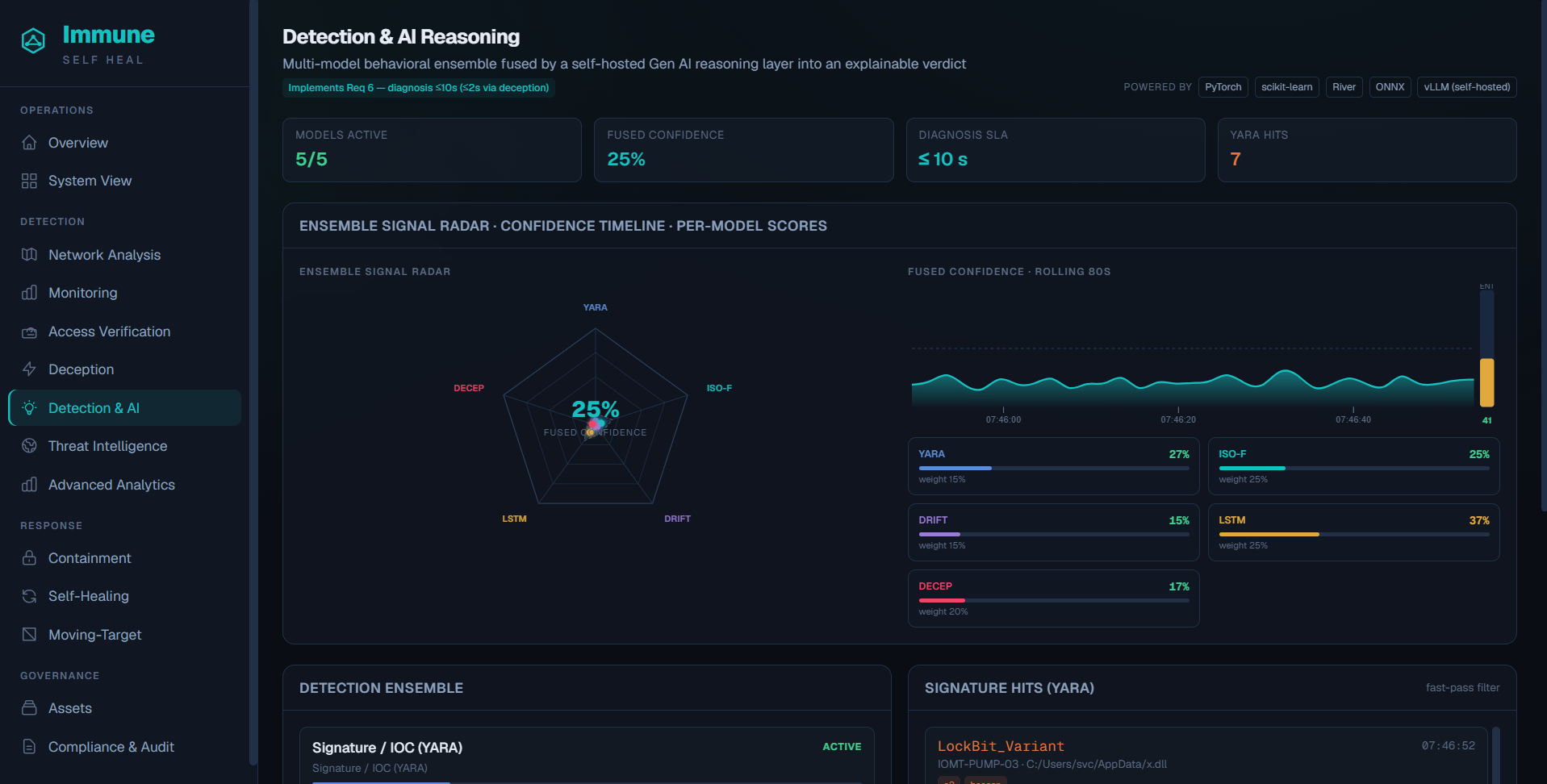
The detection console fuses signature, behavioral, and deception signals into one explainable verdict with confidence score and kill-chain stage.
Features
What the detection engine provides
Signature & indicator matching
An instant, low-cost first pass that catches known ransomware families and tools.
Anomaly detection
Statistical models that flag activity departing from your environment's learned baseline.
Sequence analysis
Models that understand the order of events, recognizing an attack's choreography as it unfolds.
Drift awareness
Adapts as normal behavior legitimately changes, keeping the baseline honest and false alarms low.
Signal fusion
Combines host, network, identity, and deception signals into one confident diagnosis.
Explainable verdicts
A plain-language summary with confidence score, attack stage, and recommended action.
How it works
How AI detection works
Screen the known
A fast signature and indicator pass catches recognized ransomware families immediately.
Model the behavior
Anomaly and sequence models compare activity to your environment's baseline to catch the unknown.
Fuse the signals
Host, network, identity, and deception inputs are weighed together, so a subtle attack still surfaces.
Reason and explain
The reasoning engine produces a verdict with confidence, kill-chain stage, blast radius, and recommended actions — in plain language.
Hand off to response
A confident verdict is acted on automatically where safe, or presented for one-click approval where care could be affected.
Advantages
The advantages of the detection ensemble
Catches the unknown
Behavioral models surface zero-day and custom ransomware with no signature.
Stays precise
Cross-signal correlation and drift-aware baselining keep false positives low.
Explains itself
Plain-language verdicts build trust and enable fast, confident action.
Runs on-premises
A self-hosted reasoning engine keeps patient data inside the hospital.
Beats living-off-the-land
Detects credential-based attacks by behavior when there's no malware to match.
Fast enough to matter
Verdicts arrive in seconds, so containment can begin before encryption spreads.
Use cases
Where AI detection proves its value
Zero-day ransomware
Catch never-seen strains through behavior rather than signatures.
Living-off-the-land attacks
Surface adversaries using legitimate tools and stolen credentials.
Alert-fatigue reduction
Replace a flood of raw alerts with one clear, explainable verdict.
Privacy-strict environments
Run detection fully on-premises where data cannot leave the hospital.
One verdict, not a thousand alerts
Detection that a team can actually act on
The chronic failure of traditional security is not too little data but too much — an ocean of disconnected alerts that no team can triage in time. Immune fuses every signal into a single diagnosis expressed in plain language: whether this is ransomware, which stage it has reached, which systems are affected, how far it could spread, and what to do about it. That clarity is what makes fast response possible and what lets people trust the decisions being made on their behalf. The AI does not replace judgment; it delivers the clarity good judgment needs.
Common questions
AI and behavioral ransomware detection, answered
+How does AI detect ransomware?
Immune's AI models learn what normal looks like for your environment and detect the behavioral patterns of ransomware — abnormal file activity, entropy spikes, lateral movement, and credential abuse — even when the specific malware has never been seen before. The models' findings are then fused with signature matching and explained in plain language.
+What is the difference between signature and behavioral detection?
Signature detection recognizes known threats by matching them to a library of patterns; it is precise but blind to anything new. Behavioral detection identifies threats by how they act rather than what they are, so it catches novel and zero-day ransomware. Immune uses both, plus deception, so nothing falls between the gaps.
+Can AI detection catch attacks that have no known signature?
Yes — that is its main advantage. Because behavioral models flag deviations from normal rather than matching known code, they surface zero-day ransomware, custom tooling, and living-off-the-land techniques that signature-only tools miss.
+Does the AI explain its decisions?
Yes. Immune produces a plain-language diagnosis with a confidence score, the stage of the attack, the affected systems, and the recommended action — so security teams can trust and act on the verdict rather than decode a cryptic alert.
+Can the AI run without sending data to the cloud?
Yes. Immune's reasoning engine can be self-hosted and run entirely on-premises, so no protected health information leaves the hospital environment — important for strict HIPAA and data-sovereignty requirements.
+How does it avoid false positives?
The ensemble correlates multiple independent signals before reaching a verdict, and drift-aware models keep the baseline honest as legitimate behavior changes over time. That combination keeps confident detections high and false alarms low.
Detect the ransomware no one has seen before
Book a demo and see how Immune's detection ensemble catches zero-day and credential-based attacks — and explains every verdict in plain language.