Industries · Schools
Ransomware protection for schools and school districts
Schools have become one of the favorite targets of ransomware groups, because districts hold a trove of student data, run open networks full of personal devices, and rarely have the budget or staff to defend themselves. The consequences are real: the PowerSchool breach in late 2024 exposed the data of around 62 million students, the largest breach of children's data in US history, and the 2022 attack on Los Angeles Unified School District ended with roughly 500GB of files leaked, including student psychological evaluations. We keep schools open and student data protected by detecting in seconds, containing before spread, and self-healing from immutable backups.
We give school districts enterprise-grade ransomware protection without an enterprise security team, and we can run it as a managed service. Student records stay protected, learning stays on, and you recover without paying a ransom.
Why ransomware hits schools hardest
Ransomware groups hunt for soft, high-pressure targets, and K-12 schools fit the profile precisely. Districts hold student names, addresses, Social Security numbers, health records, and family contact details, all of it valuable and much of it belonging to children who cannot monitor their own credit for years. At the same time, schools run open networks with thousands of personal and school-issued devices, operate on tight public budgets, and often have a handful of IT staff and no dedicated security team. When an attack lands, classes can be cancelled and the pressure to restore is immediate and public.
The threat has reached a scale that is hard to overstate. The December 2024 breach of PowerSchool, the most widely used student-information system in North American K-12 education, exposed roughly 62 million students and 9.5 million teachers across thousands of districts. Months after a ransom was paid, criminals returned to extort individual districts with the same stolen data, a reminder that paying rarely ends the story. This page is for K-12 schools and districts specifically; universities and colleges should see our higher-education page.
Why attackers keep coming back to schools
Schools combine the two things ransomware operators want most: valuable data and weak leverage against them. A district that cannot run attendance, payroll, transportation, or instruction has to resolve the incident fast, and parents and school boards apply enormous public pressure. Attackers know that many districts cannot afford a modern security program, so they probe for the open, under-monitored networks and unpatched systems that schools often run. The result is a sector that sits consistently among the top three most-attacked by ransomware.
The data stolen is uniquely sensitive. When Los Angeles Unified refused to pay Vice Society in 2022, the group leaked roughly 500GB of files, including Social Security numbers, passport details, and the psychological evaluations of about 2,000 students. Children's identities can be exploited quietly for years, which makes a school breach a long-tail harm, not a one-time event. For a district, protecting student data is not just a compliance obligation, it is a duty to the families who trusted the school with their children's information.
The third-party and open-network problem
Two structural weaknesses define school security. The first is third-party risk. Districts rely on shared platforms like student-information systems, learning-management systems, and transportation and payment vendors, and a single compromised vendor can expose thousands of districts at once. The PowerSchool breach was exactly this: one intrusion at a central provider cascaded across the whole K-12 system. The second is the open network itself, with student and staff personal devices, lab machines, and unmanaged endpoints that a traditional agent-based tool cannot fully cover.
Both weaknesses point to the same conclusion. A defense that only watches managed laptops and servers will miss the paths attackers actually use into a school: a stolen vendor credential, an unmanaged device, a shared system nobody is monitoring closely. Protecting a district means watching the network itself and the behavior on it, not just the endpoints you were able to install software on.
By the numbers
The ransomware threat to schools, in figures
The scale of the ransomware threat to K-12 schools, in figures from public reporting.
By infrastructure type
How we protect each part of the schools
A school district is many systems at once: the ones that teach, the ones that run operations, and the vendors that hold the data. Here is how we protect each, and what we keep running when an attack lands.
Student information & records
The SIS and the records it holds, grades, attendance, health, and family data, are the crown jewels attackers want. We detect abnormal access and exfiltration before student data leaves, and we keep an immutable record of exactly what happened.
- Student-information-system protection
- Exfiltration detection for double extortion
- Immutable audit for breach determination
Learning & classroom systems
Learning-management platforms, classroom apps, and the systems instruction depends on. We contain a threat fast so a district does not have to cancel classes while it recovers.
- Learning-management and classroom systems
- Seconds-scale containment
- Fast, validated recovery to keep school open
District operations
Payroll, transportation, food service, HVAC, and the back-office systems that run a district day to day. We protect them at the network level, including the operational systems that cannot run an agent.
- Payroll, transport, and facilities systems
- Agentless coverage for building and OT systems
- Priority-order recovery
Third-party & vendor connections
The SIS, LMS, and service vendors that a single breach can turn into a district-wide exposure, as PowerSchool showed. We give network-level visibility into those connections and the data moving across them.
- Vendor-connection visibility
- Detection of compromised third-party access
- Alerts on abnormal data flows to and from vendors
Our solution
How Immune protects schools and school districts
Immune's detect, contain, and self-heal platform, tailored to the realities of schools.
Student-data protection
Detects the abnormal access and exfiltration that precede a student-data breach, before records leave.
Open-network coverage
Network-level detection across the open, device-heavy networks districts run, including unmanaged devices.
Managed option for lean IT
Enterprise-grade detection, containment, and recovery, run for you if your district has no security staff.
Learning continuity
Keeps learning and operational systems available through an attack so classes do not stop.
Third-party risk visibility
Network-level insight into the SIS, LMS, and vendor connections a single breach can exploit.
Automated containment
Isolates a threat in seconds to keep an incident from spreading district-wide.
Immutable audit
Tamper-proof logging that supports FERPA and state breach-notification obligations.
Fast, validated recovery
Restores systems from verified, immutable backups so you recover without paying a ransom.
See it in action
The Immune console, working on a schools environment
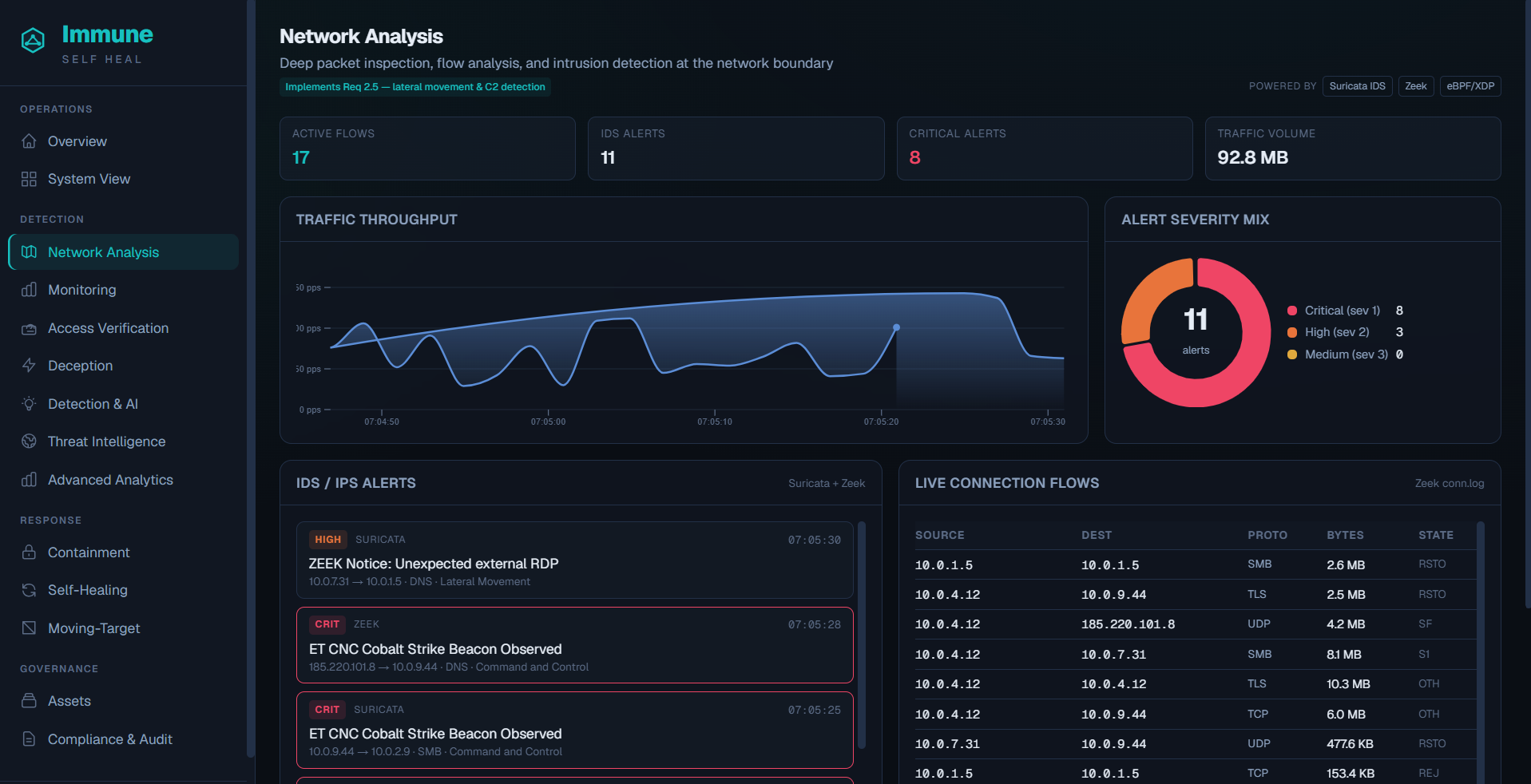
Network analysis surfaces abnormal data flows before student records leave
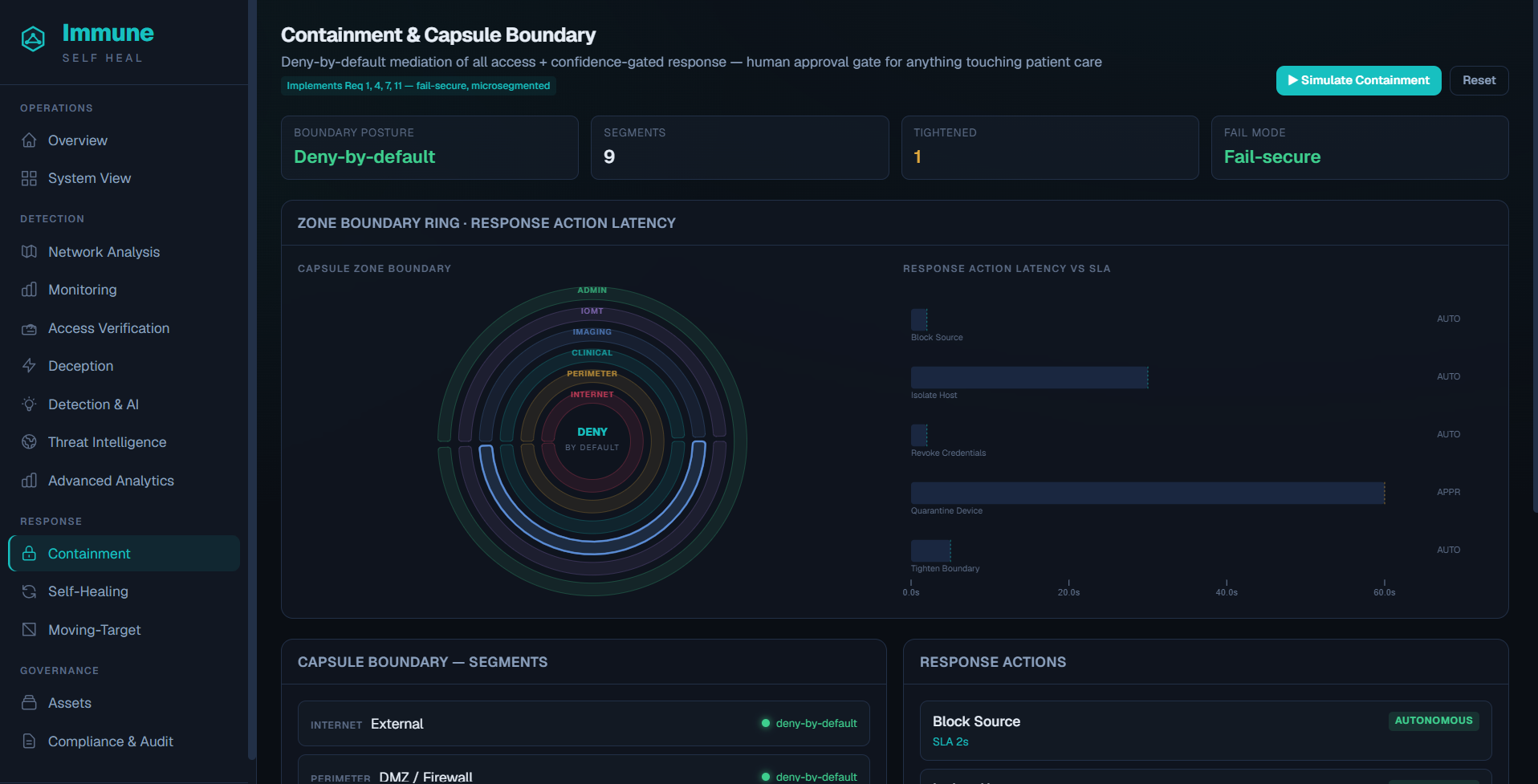
Automated containment stops a district-wide spread in seconds
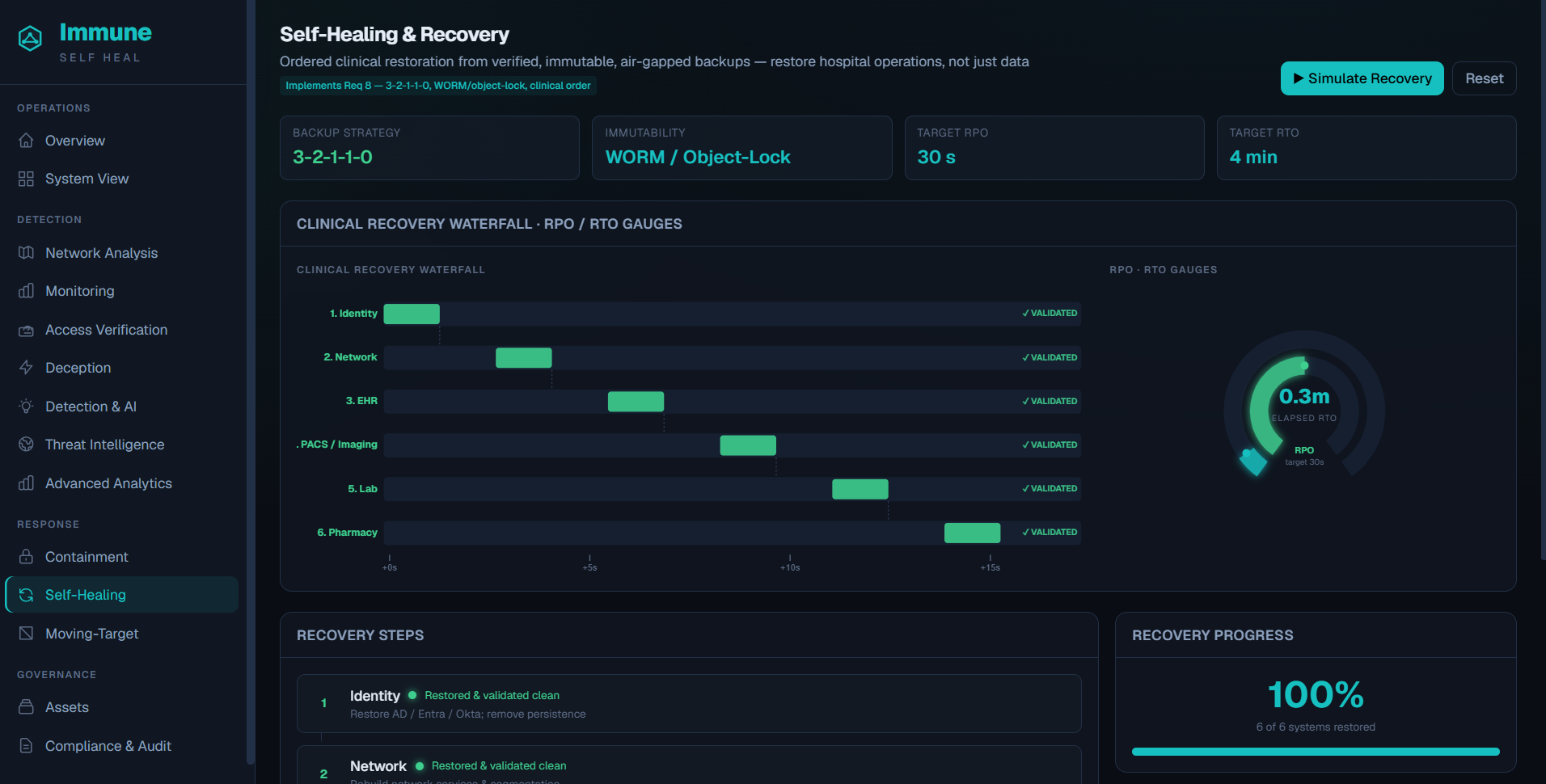
Self-healing recovery restores learning and operations without paying a ransom
The solution, in depth
How we actually protect schools and school districts, in technical terms
District technology leaders want to know exactly how the protection works and whether it fits a small team and a tight budget. Here is the mechanism, piece by piece. It is the same platform we run everywhere; what follows is how it applies to the systems and constraints specific to K-12 schools.
We give a small district team enterprise-grade protection
The hard truth behind most school attacks is a tiny IT team with no dedicated security staff and a budget that cannot stretch to a security operations center. We are built for that reality. Detection, containment, and recovery are automated, so the platform does the heavy lifting around the clock, and we can run the entire thing for you as a managed service. A district gets the same resilience a large enterprise would, without having to hire people it cannot afford.
- Automated detection and containment, no large team required
- Managed service option for districts with no security staff
- Broad network-level coverage without an agent on every device
We protect the open network, not just managed laptops
Schools run open networks full of student and staff personal devices, lab machines, and unmanaged endpoints that an agent-based tool cannot fully cover. We watch the network itself and the behavior on it, so an intrusion through an unmanaged device or a stolen credential is caught even when there is no agent on the machine the attacker used. That matters enormously in an environment where you simply cannot install software on every device a student brings through the door.
We detect student-data theft before it becomes a public leak
Modern school attacks are double extortion: the data is stolen first, then threatened with release, as Vice Society did when it dumped LAUSD's files, including student psychological evaluations. The race is to catch the theft while it happens. Our network-level detection and deception surface the large, abnormal outbound transfers and the reconnaissance that precede exfiltration, so the goal is to stop children's records from leaving rather than discovering the loss on a leak site.
We watch the third-party connections that caused the worst breaches
The PowerSchool breach proved that a district's biggest risk may not be its own network at all, but a vendor's. We give network-level visibility into the connections to student-information systems, learning platforms, and service vendors, and we flag abnormal access or data movement across them. If a trusted vendor connection starts behaving like an attacker, we surface it rather than waving it through because the credential is valid.
We recover fast, so a district does not have to pay
Independent recovery is what removes an attacker's leverage. We keep verified, immutable, air-gapped backups that ransomware cannot alter or delete, because attackers target ordinary backups first. We confirm a backup predates the attack, verify it is clean, and restore in priority order so the systems a school needs most come back first. That capability is what let districts like Los Angeles Unified refuse to pay, rather than funding criminals to get their own data back, and it is what we build for every district we protect.
The technical flow, step by step
We place a network sensor across your district and lightweight agents where they fit, with a managed option if you have no security staff of your own.
Over about two weeks we learn normal activity across your SIS, learning platforms, operations, and vendor connections.
Mass file encryption, a touched canary file, abnormal data transfers, or an account reaching systems it never uses each raise a high-confidence signal in seconds.
The AI fuses the signals into one plain-language verdict with a confidence score and blast radius, so a small team knows exactly what is happening.
We isolate the affected systems automatically to stop a district-wide spread, around the clock, with high-impact actions gated for approval.
We restore from verified, immutable backups in priority order so classes and operations come back fast, without paying a ransom.
A tamper-proof audit trail documents the whole response for FERPA, state breach-notification rules, and the school board.
Compliance
Aligned to schools regulation
Our controls map to the compliance and operational-resilience expectations placed on schools and school districts.
FERPA (student records)
The Family Educational Rights and Privacy Act governs the confidentiality of student education records. Our detection, access controls, and immutable audit support a district's duty to protect and account for that data.
State student-data-privacy laws
Many states impose specific student-data-protection and breach-notification rules on districts and their vendors. Clear, tamper-proof incident records support an accurate, defensible determination.
CIPA and network safeguards
Districts operate under network-safety expectations tied to federal programs. Our network-level protection complements those safeguards against ransomware.
Breach notification
A student-data breach triggers notification duties to families and, often, the state. Our evidence-grade records make that notification accurate rather than worst-case guesswork.
Use cases
Where Immune protects schools and school districts
District-wide ransomware attack
Contain a threat before it cancels classes and takes a district's systems offline.
Student-data theft
Detect exfiltration of student records in progress and recover cleanly to remove leverage.
Compromised vendor / SIS
Surface abnormal access from a trusted third-party connection before it becomes a breach.
Unmanaged-device intrusion
Catch an attack that enters through a device no agent could be installed on.
Follow-on extortion
Detect and document renewed extortion attempts after an initial incident.
Recovery without paying
Restore from immutable backups so a district can refuse the ransom.
Real incidents
Schools ransomware attacks: what really happened
K-12 schools do not have to imagine a ransomware attack. The incidents below are real and publicly reported, with sources, and together they show how broadly and how deeply the threat reaches into schools.
PowerSchool (K-12 student-information system)
December 2024An attacker exploited a gap in PowerSchool's support portal and stole the personal data of roughly 62 million students and 9.5 million teachers across about 6,500 districts, the largest breach of children's data in US history. PowerSchool reportedly paid a ransom, yet months later criminals returned to extort individual districts with the same stolen data.
Source: Security.org / Forbes / Fisher Phillips
Los Angeles Unified School District (Vice Society)
September 2022The Vice Society group attacked the second-largest US school district. When LAUSD refused to pay, the group leaked roughly 500GB of files, including Social Security numbers, passport details, and the psychological evaluations of about 2,000 students, one of the largest education breaches on record.
Source: TechCrunch / Axios / Cybersecurity Dive
New Jersey school districts (LockBit)
2023–2024LockBit claimed ransomware attacks on New Jersey's Township of Union and Bayonne school districts, causing significant network disruption and posting stolen documents, part of a sustained campaign against the education sector.
Source: Comparitech / NJ1015
Common questions
Ransomware protection for schools, answered
+Why are schools such a common ransomware target?
Schools hold large amounts of sensitive student and staff data, run open networks with thousands of personal devices, and usually operate on tight budgets with small IT teams and no dedicated security staff. That combination of valuable data and limited defenses makes K-12 one of the top-three most-targeted ransomware sectors year after year.
+How does Immune protect student data?
We detect the abnormal, large-scale data transfers and access patterns that precede a student-data theft, so an attacker trying to exfiltrate records is surfaced before the data leaves. Every action is written to a tamper-proof audit log, which supports a FERPA and state breach-notification determination based on evidence rather than guesswork.
+Is Immune affordable and practical for a small district IT team?
Yes. Detection, containment, and recovery are automated, and we can run the whole platform for you as a managed service. A district gets enterprise-grade resilience without having to build or staff a security operations center it cannot afford.
+Can Immune protect against a PowerSchool-style third-party breach?
We give network-level visibility into the connections to your student-information system, learning platform, and service vendors, and we flag abnormal access or data movement across them. If a trusted vendor connection starts behaving like an attacker, we surface it rather than trusting it because the credential is valid.
+Does Immune require an agent on every student device?
No. We protect at the network level, so we cover the open, device-heavy environment of a school, including unmanaged personal devices and lab machines that cannot host an agent, without needing software on each one.
+How does Immune help a district avoid paying a ransom?
We keep verified, immutable, air-gapped backups and restore systems in priority order, so a district can recover on its own, the way Los Angeles Unified chose to, rather than funding criminals to get its own data back. Paying rarely ends the story anyway, as the PowerSchool follow-on extortion showed.
+What is the difference between this page and the higher-education page?
This page is for K-12 schools and school districts. Universities, colleges, and research institutions should see our higher-education page, which addresses open campus networks and research-data protection. Many of the underlying capabilities are shared, but the systems and constraints differ.
References
Sources and further reading
Every incident and figure on this page is drawn from public reporting. The primary sources are listed below.
- 1.Security.org: PowerSchool data breach, what happened and what families should do
- 2.Fisher Phillips: PowerSchool cybercriminal returns to extort individual schools
- 3.TechCrunch: Hackers leak 500GB trove stolen during LAUSD ransomware attack
- 4.Cybersecurity Dive: Los Angeles school district confirms sensitive student data leaked
- 5.Comparitech: LockBit claims cyber attack on Union, NJ schools
- 6.U.S. Dept. of Education: FERPA (student-records privacy)
Other industries
Ransomware protection for other industries
Immune protects critical systems across sectors. Explore ransomware protection tailored to other industries.
Explore the platform
Related capabilities
Keep your schools operation running through ransomware
See how Immune detects, contains, and self-heals critical systems for schools and school districts.