Access Verification
Continuous access verification that catches valid-credential attacks
The hardest ransomware to catch doesn't break in — it logs in. Immune verifies every internal access request continuously, scoring it against normal behavior, so an attacker using stolen credentials is caught even when everything about the login looks legitimate.
Immune assigns a trust score to every internal access request and re-evaluates it throughout the session, catching credential abuse and living-off-the-land attacks that signature-based tools wave straight through.
The attacker who has your keys
A great deal of security is built to keep intruders out. But some of the most damaging ransomware attacks begin with an intruder who is already, in a technical sense, allowed in. They have obtained a valid credential — phished from a staff member, bought from a broker, or harvested from an earlier breach — and they use it to log in like any legitimate user. Once inside, they rely on the same administrative tools your own IT team uses. To a defense that checks whether a login is valid or whether software is known-malicious, nothing looks wrong. This is the living-off-the-land problem, and it is precisely why so many well-defended hospitals still fall.
The way to catch this kind of attacker is not to ask whether the credential is valid — it is — but whether the behavior behind it matches the person it belongs to. A specific nurse, a specific service account, a specific workstation each have a characteristic pattern: the systems they touch, the hours they work, the volume and rhythm of their activity. An attacker wielding a stolen credential does not know or replicate that pattern. A backup service account does not normally browse individual patient records at three in the morning. An identity behaving nothing like its own history is a red flag no matter how valid its password is.
See it in action
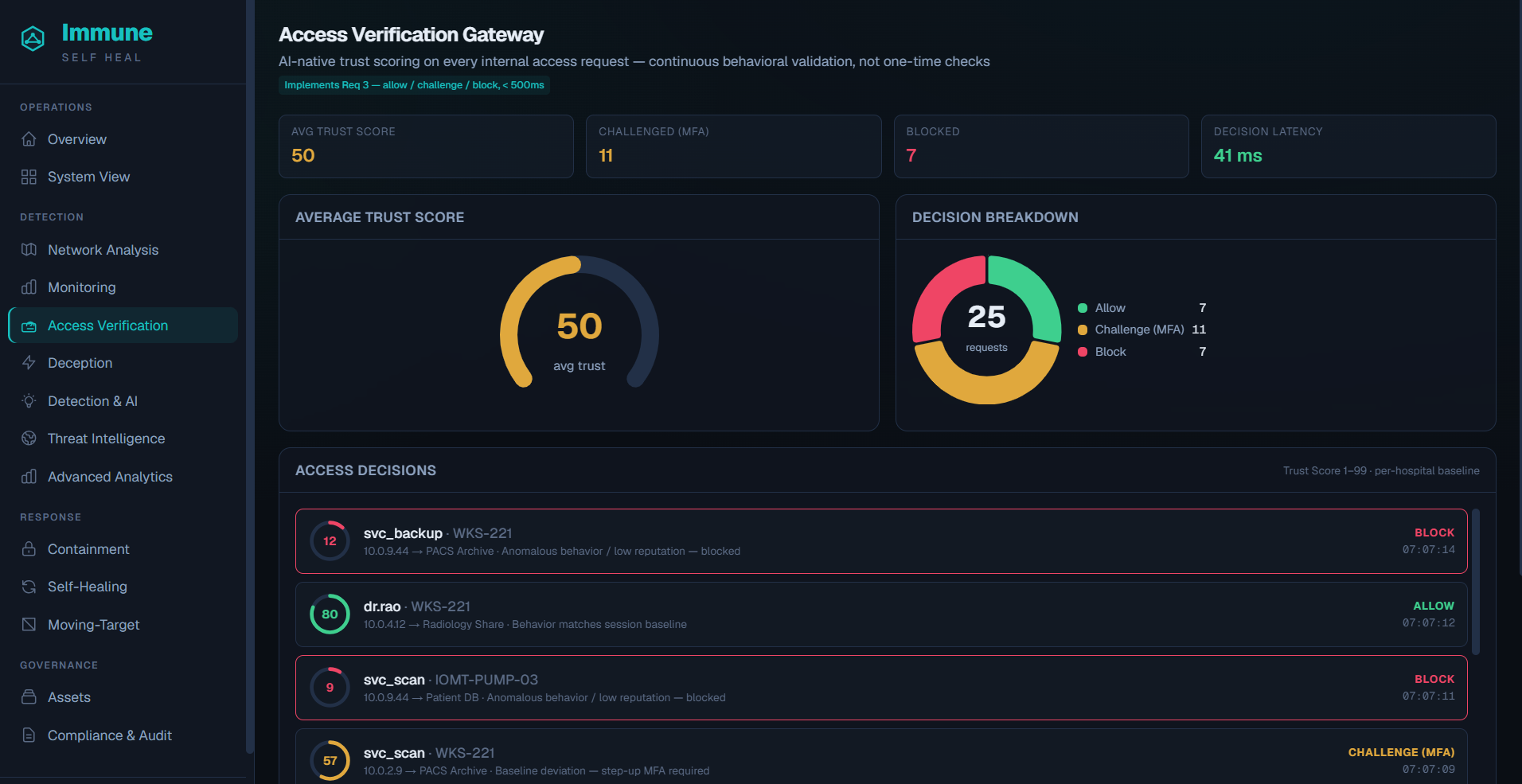
Every internal access request scored in real time against the user's behavioral baseline — valid-credential attacks surface the moment behavior deviates.
Features
What access verification provides
Behavioral baselining
A normal-behavior profile for each identity, device, and credential, learned for your environment.
Continuous trust scoring
Every request receives a trust score; the session is re-evaluated whenever behavior deviates.
Graduated response
Trusted requests pass freely, borderline ones prompt step-up MFA, anomalous ones are blocked.
Credential-abuse detection
Valid credentials behaving abnormally are caught, closing the living-off-the-land gap.
Service & machine identity coverage
Baselines the non-human accounts attackers abuse most, not just people.
Identity provider integration
Works with your existing identity systems to enforce decisions in real time.
How it works
How continuous verification works
Learn the baseline
Immune builds a behavioral profile for each user, device, and credential — the systems, hours, and volume that are normal for them.
Score every request
Each attempt to reach a protected system is scored in real time against that baseline, not just at login.
Decide the response
High-trust requests pass without friction; borderline ones trigger a step-up check; clearly anomalous ones are blocked.
Re-evaluate continuously
Trust is re-checked throughout the session, so behavior that turns suspicious after login is still caught.
Feed the platform
A low trust score raises the sensitivity of every other detection method and can trigger containment.
Advantages
The advantages of behavior-based access verification
Closes the credential gap
Catches the valid-login attacks that signatures and antivirus cannot see.
Beats living-off-the-land
Detects attackers using legitimate tools by how they behave, not what they run.
No friction for clinicians
Normal behavior flows through untouched; only anomalies are challenged.
Zero trust made practical
Applies never-assume-trust without grinding a busy hospital to a halt.
Catches the quiet middle
Flags an attacker moving on stolen credentials long before encryption begins.
Covers machines too
Baselines service and machine identities — the credentials attacks abuse most.
Use cases
Where access verification protects you
Stolen-credential intrusions
Logins that pass every traditional check but behave nothing like the real user.
Living-off-the-land attacks
Adversaries using built-in admin tools and no malware to stay invisible.
Compromised service accounts
Machine identities suddenly reaching systems far outside their normal scope.
Insider-style misuse
An account used well outside its established pattern of behavior.
Why it matters
Trust that is earned continuously, not granted once
The principle behind this is often called zero trust: never assume a user, device, or request is safe simply because it made it past the front door. Immune makes it practical by anchoring trust in behavior rather than in constant challenges. Clinicians going about their normal work are not interrupted, because their behavior matches their baseline. The friction is reserved for the requests that genuinely warrant it. Access verification catches the attacker in the long, quiet middle of the kill chain — while they are moving on stolen credentials and long before they reach the point of encryption.
Common questions
Access verification and zero trust, answered
+How do you stop attackers using valid stolen credentials?
Immune verifies access continuously rather than trusting a login once. Every request to reach a protected system is scored against the established behavior of that user, device, and credential. When behavior departs from the norm — unusual hours, unusual targets, unusual volume — the request is challenged or blocked even though the credential is valid.
+What is continuous access verification?
It is the practice of re-evaluating trust throughout a session instead of granting it once at login. Because attackers who steal credentials behave differently from the real user, continuous verification catches them mid-session rather than waving them through.
+What are living-off-the-land attacks?
Living-off-the-land attacks use legitimate credentials and built-in administrative tools instead of malware, so they leave little for signature-based defenses to detect. Behavioral access verification is one of the most effective ways to catch them, because the attacker's behavior still differs from the legitimate user's.
+Does access verification add friction for clinicians?
No. Legitimate behavior that matches the established baseline flows through without interruption. Only anomalous requests trigger a step-up check or a block, so clinical staff are not slowed by routine access.
+How is this different from multi-factor authentication?
MFA verifies identity at the moment of login. Continuous access verification keeps evaluating behavior after login, so a session hijacked or a credential misused after a valid sign-in is still caught. The two are complementary, and Immune can trigger a step-up MFA challenge when a request looks borderline.
+Does it work for service accounts and machines, not just people?
Yes. Immune baselines the behavior of service accounts, devices, and machine identities too — often the most abused credentials in a ransomware attack — and flags them when they act outside their normal pattern.
Explore the platform
Related capabilities
Stop the attacker who logs in with your own keys
Book a demo and see how Immune catches valid-credential and living-off-the-land attacks through continuous behavioral access verification.