
Agentless IoMT Protection
Medical device ransomware protection for systems that can't defend themselves
Connected medical devices are among the most exposed systems in any hospital and the hardest to protect. Immune secures them where they live — on the network — so infusion pumps, imaging controllers, and legacy clinical systems are covered even though they can't run a security agent.
Most security tools need an agent on the device. Medical devices usually can't run one. Immune closes that blind spot by protecting them at the network boundary and quarantining threats without ever shutting a device down.
Why medical devices are the soft underbelly of hospital security
Walk through any modern hospital and you are surrounded by computers that do not look like computers. Infusion pumps meter medication. Imaging systems capture and store scans. Patient monitors stream vital signs. Ventilators, dialysis machines, and dozens of other devices quietly run software and connect to the network. Collectively they are the Internet of Medical Things, and a single large hospital may operate ten to fifteen thousand of them. They are essential to care, and they are a security nightmare.
The problem is structural. These devices are built to be medical instruments first and network citizens second. Many run old or proprietary operating systems that were never designed to host security software. Research across millions of medical devices has found they carry an average of more than six known vulnerabilities each, that the majority of hospitals operate at least one device with a vulnerability attackers are actively exploiting, and that a large share of devices in active use are end-of-life. You cannot patch your way out of this, and you cannot install an agent on a device that will not accept one.
Attackers understand all of this. As endpoint protection has improved on laptops and servers, adversaries have shifted toward the systems that endpoint tools cannot see. Ransomware aimed at hospital connected devices has climbed sharply, because a compromised imaging system or a foothold on an unmonitored device gives an attacker a quiet place to hide and a bridge into the rest of the network.
See it in action
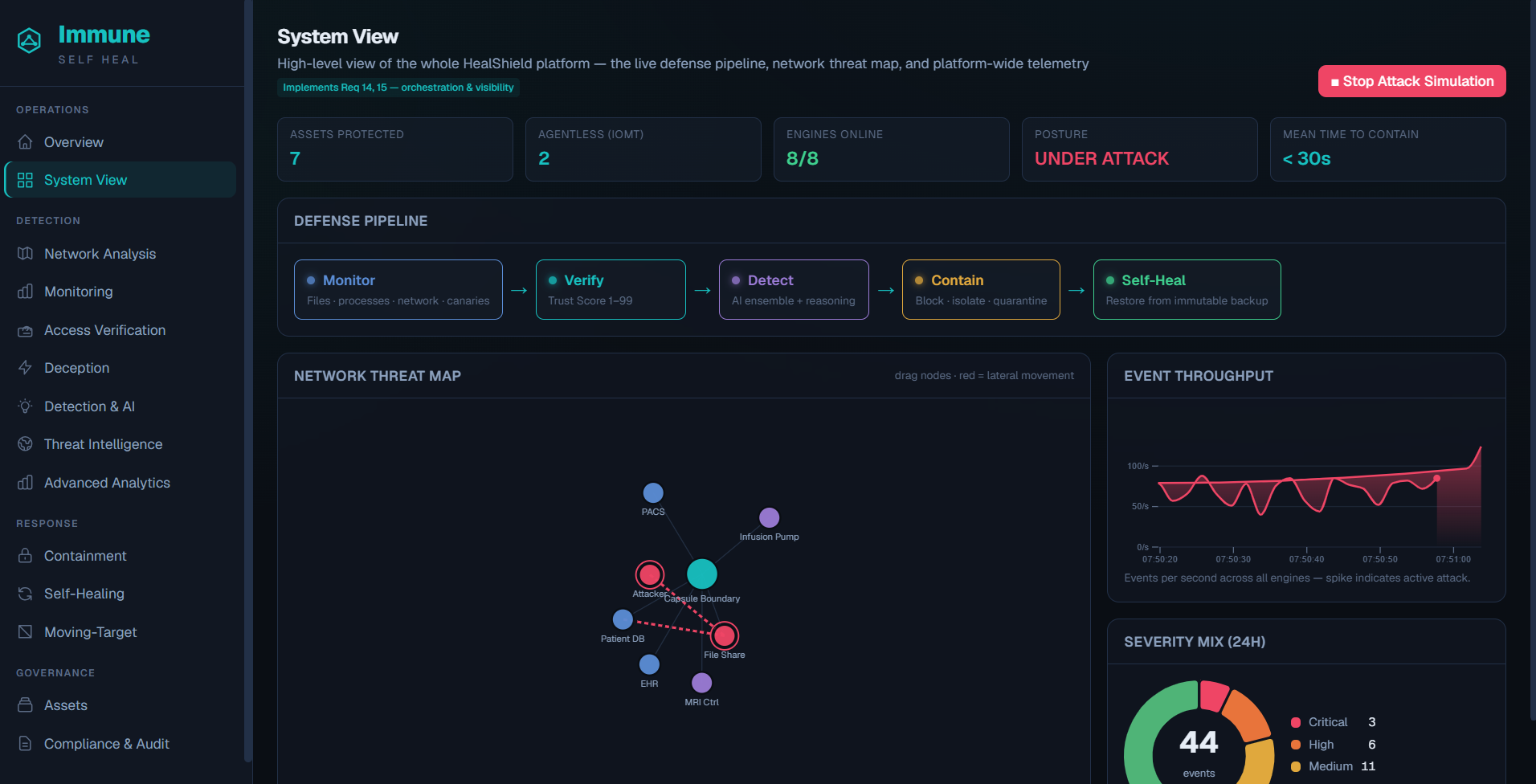
Every connected medical device discovered on the network — classified, risk-scored, and protected at the boundary without an agent.
Features
What medical-device protection includes
A complete set of capabilities for securing the connected devices conventional tools can't reach.
Agentless coverage
Protects devices at the network boundary — no software required on the device itself.
Per-device behavioral baseline
Learns the normal traffic pattern of each device so deviations are obvious.
Automatic device discovery
Finds and classifies connected devices on the network, including unmanaged ones.
Network quarantine, not shutdown
Isolates a compromised device's connectivity while keeping it powered and clinically functional.
IoMT-aware threat detection
Recognizes the abnormal behavior that signals a device is being used in an attack.
Legacy & end-of-life support
Protects unpatchable systems that will never receive another security update.
How it works
How Immune protects an agentless device
Discover and classify
Immune identifies every connected device on the network and classifies what it is — pump, imaging system, monitor, or legacy system.
Baseline normal behavior
It learns each device's characteristic communication: which systems it talks to, on which protocols, and in what volume and timing.
Watch at the boundary
Every device's traffic is monitored continuously at the network boundary, where an attack on an agentless system becomes visible.
Detect the deviation
When a device reaches for systems it never touches, beacons to an unfamiliar destination, or moves toward the health record, Immune flags it as a high-priority threat.
Quarantine safely
On a confirmed threat, Immune isolates the device at the network layer — cutting the attacker off while leaving the device powered and safe for the patient.
Advantages
The advantages of protecting devices on the network
Closes the primary entry point
The agentless fleet is where many hospital attacks begin; covering it removes that opening.
Covers a huge share of the attack surface
Thousands of previously-invisible devices become monitored, not a rounding error.
Safe by design
Quarantine at the network layer never powers down a device a patient depends on.
No performance impact on devices
Protection happens off the device, so sensitive medical equipment is untouched.
Works with what you have
Complements endpoint tools and backups by covering the systems they structurally cannot.
A defensible differentiator
Agent-based competitors cannot match network-boundary protection for these devices.
Use cases
Where agentless protection matters most
Infusion pumps & bedside devices
Medication-delivery devices that cannot host software and must never be shut down.
Imaging & PACS archives
Diagnostic imaging systems and the archives that store scans — frequent ransomware targets.
Patient monitors & telemetry
Continuous vital-sign systems whose availability is a patient-safety matter.
Legacy & end-of-life systems
Unpatchable clinical systems that remain in service long past vendor support.
Why this is decisive
The blind spot other tools leave open
The leading endpoint and detection products are genuinely good — on devices that can run their agent. Ask them to protect an infusion pump or a decade-old imaging controller, and they cannot, because there is nowhere to install the software. The industry openly acknowledges this: attackers go where agents cannot, and in a hospital that means the medical devices. Backup-centric tools have the same gap; they can help you recover data, but they do nothing to stop a device from being used as an attack path in the first place. Immune was designed from the start to cover exactly this territory — protecting the systems that cannot protect themselves is a founding reason the platform exists.
Common questions
Medical device and IoMT security, answered
+What is IoMT security?
IoMT (Internet of Medical Things) security is the practice of protecting connected medical devices — infusion pumps, imaging systems, monitors, and similar equipment — from unauthorized access, manipulation, and disruption, while keeping them safely available for patient care. Because many of these devices cannot run security software, IoMT security is usually enforced at the network layer.
+How do you protect medical devices that can't run a security agent?
Immune protects agentless devices at the network boundary rather than on the device itself. It baselines each device's normal behavior, watches its traffic continuously, and — on a confirmed threat — quarantines the device at the network layer so the attacker is cut off while the device stays powered and safe.
+Why can't EDR or antivirus protect medical devices?
Endpoint detection and antivirus require installing an agent on the device. Most medical devices run closed or unsupported operating systems that cannot host one, and a large share are end-of-life with no patches. That leaves them invisible to endpoint tools — a blind spot attackers deliberately target.
+Does quarantining a device put patients at risk?
No. Immune quarantines at the network layer — it isolates the device's connectivity, it does not power it off or interrupt its clinical function. Any action that could affect care is gated behind human approval, so a clinician remains in control of the device itself.
+What kinds of devices can Immune protect?
Infusion pumps and bedside devices, imaging systems and PACS archives, patient monitors and telemetry, laboratory and diagnostic equipment, legacy and end-of-life clinical systems, and the operational-technology systems that share the clinical network.
+How does Immune know a device is behaving abnormally?
Immune learns a behavioral baseline for each device — the systems it talks to, the protocols it uses, and its normal volume and timing. Because medical-device behavior is highly predictable, deviations such as new destinations, beaconing, or attempts to reach the health record stand out clearly and quickly.
Explore the platform
Related capabilities
Cover the devices your current tools can't see
Book a demo and we'll show you how Immune protects agentless medical devices at the network boundary — and quarantines threats without ever disrupting patient care.