Self-Healing & Recovery
Ransomware recovery that brings the hospital back in minutes
Stopping an attack is only half the job. Immune finishes it by self-healing — restoring clinical systems from verified, immutable backups in the right order and confirming each is clean, so operations resume in minutes rather than the weeks that manual recovery so often takes.
Immune's self-healing recovery restores affected systems from immutable, air-gapped backups in clinical dependency order, validates each is clean before it returns to service, and reports recovery time and data-loss objectives for every event.
Why recovery, not just detection, decides the outcome
When a hospital makes headlines for a ransomware attack, the story is almost never about the moment of intrusion. It is about the aftermath — the weeks of diverted ambulances, cancelled procedures, and paper charts while teams struggle to rebuild their systems. That aftermath is a recovery failure, and it is where the true cost of ransomware lives. Independent analysis puts hospital downtime at roughly seven and a half thousand dollars per minute, reaching millions of dollars per hour for larger systems. Every hour shaved off recovery is money saved and, more importantly, care restored.
Yet recovery is the part of the security lifecycle that most organizations have thought about least. Many assume their backups will save them, only to discover during a crisis that the backups were encrypted too, or that restoring them takes days, or that no one had ever tested a full restore. Attackers exploit this precisely: they hunt down and destroy backups early in an attack, because they know an organization that cannot recover is an organization that will pay. Recovery, in other words, is not a safety net you can take for granted — it is a capability you have to engineer.
See it in action
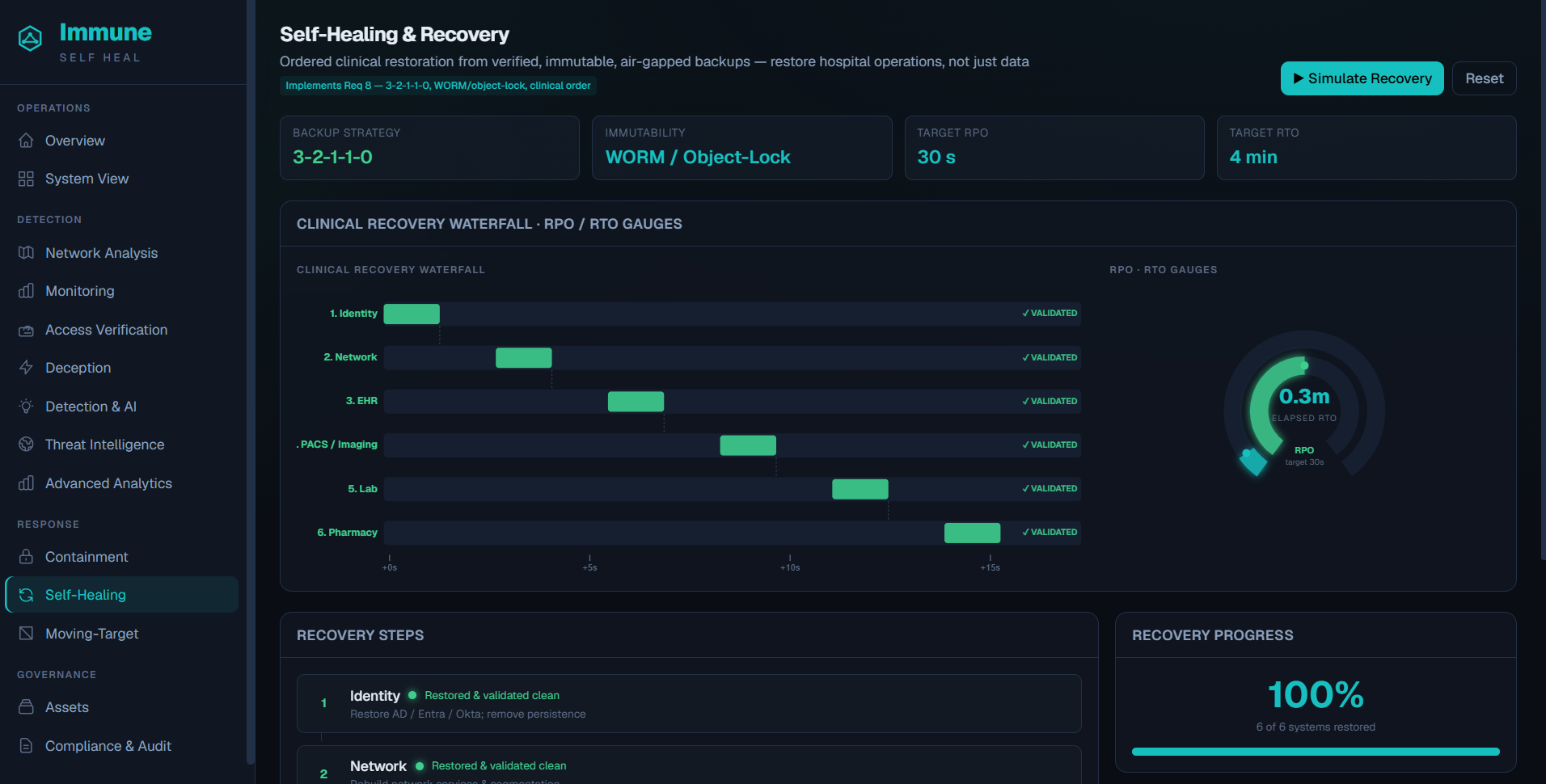
The recovery console orchestrates restore in clinical dependency order — every step tracked, every system validated clean before it returns to service.
Features
What self-healing recovery provides
Immutable, air-gapped backups
Recovery points that cannot be altered or deleted — not by an attacker, not by stolen credentials.
Integrity & pre-attack verification
Confirms a backup predates the attack and passes an integrity check before restoring.
Clinical-order orchestration
Restores identity and network first, then the EHR, then imaging, lab, and pharmacy.
Clean validation
Checks each restored system for lingering compromise before returning it to service.
RTO / RPO reporting
Reports recovery time and data-loss objectives achieved for every event.
No ransom dependency
Clean restores remove the attacker's leverage — you never have to consider paying.
How it works
How self-healing recovery works
Maintain immutable recovery points
Long before any attack, Immune keeps backups that ransomware cannot alter or delete, following a 3-2-1-1-0 strategy.
Confirm the clean point
When recovery begins, Immune verifies a backup predates the attack and passes an integrity check.
Restore in clinical order
Systems come back in dependency order — identity and network, then the EHR, then the systems that rely on it.
Validate each system
Every restored system is checked for lingering compromise before it is returned to active service.
Report the outcome
Immune records the recovery time and data-loss objectives achieved, turning recovery into something you can prove.
Advantages
The advantages of engineered recovery
Recovery in minutes to hours
Not the days or weeks that manual rebuilds routinely take.
Attacker-proof backups
Immutable, air-gapped recovery points can't be destroyed as part of the attack.
Provably clean restores
Verified pre-attack and integrity-checked, then validated before going live.
No ransom leverage
Because you can restore cleanly, the attacker's extortion loses its power.
Correct by construction
Clinical-order restoration avoids the cascading failures of ad-hoc recovery.
Audit & insurance ready
Documented recovery objectives support compliance and cyber-insurance requirements.
Use cases
Where self-healing recovery is essential
EHR restoration
Bring the electronic health record back first, cleanly, with the services it depends on.
Imaging & PACS recovery
Restore diagnostic imaging archives in their proper sequence after an attack.
Whole-hospital recovery
Orchestrate a full, ordered restoration across identity, network, and clinical systems.
Post-incident assurance
Prove to auditors and insurers that recovery objectives were met and systems verified clean.
Order is everything
Why a fast backup is not a fast recovery
Clinical systems depend on one another in intricate ways. The electronic health record will not function correctly without identity and network services beneath it. Imaging, laboratory, and pharmacy systems in turn depend on the record. Restore them in the wrong order and you get a cascade of failures and hours lost to troubleshooting — even if every individual backup was perfect. Immune encodes the correct clinical recovery order and orchestrates the restore accordingly, so systems come back in a sequence that actually works. That is the difference between having backups and having recovery.
Common questions
Ransomware recovery and self-healing, answered
+How fast can a hospital recover from ransomware?
With Immune, recovery is measured in minutes to hours rather than the days or weeks that manual recovery often takes. It restores from verified, immutable backups in clinical dependency order and validates each system before returning it to service.
+Why aren't ordinary backups enough against ransomware?
Modern attackers target backups first, deleting or encrypting them to remove your escape route. Ordinary backups can also be slow and unproven to restore. Immune maintains immutable, air-gapped recovery points that attackers cannot alter, and orchestrates a fast, validated restore.
+What is self-healing recovery?
Self-healing means the platform automatically restores affected systems to a clean, working state after an attack is contained — verifying the backup predates the attack, restoring in the right order, and confirming each system is clean before it goes back into service.
+What are RTO and RPO, and why do they matter?
Recovery Time Objective (RTO) is how quickly systems must be back; Recovery Point Objective (RPO) is how much data you can afford to lose. Immune is designed to meet strict clinical RTO and RPO targets and reports both for every recovery.
+Why does the order of restoration matter?
Clinical systems depend on one another — the health record needs identity and network services beneath it, and imaging, lab, and pharmacy systems depend on the record. Restoring in the wrong order causes cascading failures. Immune restores in the correct clinical dependency order so systems come back working.
+How do you know a restored system is actually clean?
Immune verifies that the chosen backup predates the attack and passes an integrity check, then validates each restored system for lingering compromise before returning it to service — so recovery is provable, not a hopeful guess.
Explore the platform
Related capabilities
Recover in minutes, without paying a ransom
Book a demo and see how Immune self-heals clinical systems from immutable backups — in the right order, verified clean, with recovery objectives you can prove.