Ransomware Protection · New Jersey
Ransomware protection for New Jersey pharma, healthcare, and finance
New Jersey is a global pharmaceutical and life-sciences powerhouse, a major financial-services corridor, and home to one of the densest healthcare sectors in the country. All that high-value data and critical operations in one place makes it one of the most heavily targeted states for ransomware. When the LockBit group hit Capital Health in late 2023, it caused a two-week IT outage, disrupted surgeries and imaging, exposed more than 500,000 people, and ended in a $4.5 million settlement. We keep New Jersey organizations running through an attack by detecting in seconds, containing the spread, and self-healing from immutable backups.
We add the resilience layer New Jersey organizations need: agentless coverage for the medical devices endpoint tools cannot reach, continuous verification of every access, and validated recovery. It protects the pharma companies, financial firms, hospitals, and governments that drive the Garden State's economy.
Your solution
How we secure your New Jersey organization
You probably found this page because you are responsible for protecting a New Jersey organization, and you want to know one thing: how do we actually stop what happened to Capital Health from happening to you. Here is the direct answer, by the kind of organization you run. Each one follows the same engine, but the systems we protect and the way we recover them are tailored to you.
If you run a hospital or health system in New Jersey
A single intrusion can divert your ambulances, cancel surgeries, knock out the EHR, and expose hundreds of thousands of patient records, exactly as it did at Capital Health and the Ardent-run Mountainside and Pascack Valley hospitals. Your biggest blind spot is the ten-to-fifteen thousand connected medical devices that cannot run a security agent.
We keep the hospital running through an attack instead of just alerting you to it. We cover the agentless devices your EDR cannot see, contain a threat in seconds with any care-impacting action held for one-click approval, and restore clinical systems from immutable backups in care-priority order. Everything can run on-premises, so patient data never leaves your walls.
A network sensor sits at your IT/OT boundary and lightweight agents go where they fit. Nothing needs to be installed on a medical device, and the analysis engine can run entirely inside your hospital.
Over about two weeks we learn what normal looks like for your network traffic, logins, and file-change patterns, so we can tell an attack apart from a busy Monday.
A sudden spike in file-encryption activity, a touched canary file, abnormal east-west traffic, or a credential behaving unlike itself each raise a high-confidence signal in seconds.
The AI fuses those signals into one plain-language verdict with a confidence score and the blast radius, so your team is not drowning in disconnected alerts.
We microsegment the affected host or device, revoke the compromised session, and block the source within about thirty seconds. Anything that could affect a patient waits for one-click human approval.
We restore from verified, immutable, air-gapped backups in clinical order, identity and network first, then EHR, then imaging, lab, and pharmacy, validating each system is clean before it returns to service.
Every action is written to a tamper-proof audit log, the evidence you need for a HIPAA and N.J.S.A. 56:8-163 breach determination and any litigation that follows.
If you run a pharmaceutical or life-sciences company in New Jersey
Attackers want your proprietary research, clinical-trial data, and manufacturing IP, which can be worth more than any ransom, and a compromise can cross from IT into the operational technology that runs physical production and halt the line.
We catch the abnormal data flows that precede research theft before the exfiltration finishes, and we protect the IT/OT boundary so an attack cannot jump into production. If encryption does occur, we restore clean systems fast and keep the immutable evidence your regulators and partners expect.
Sensors watch both your corporate network and the IT/OT boundary into manufacturing, on-premises so your IP never leaves your environment.
We learn normal data-movement and access patterns across research, corporate, and production networks.
Large or unusual data transfers out of a research share, lateral movement toward production systems, or a credential acting out of character each trigger an immediate signal.
The platform scores the event and tells you whether it is exfiltration, pre-encryption staging, or an OT-bound intrusion, with the systems at risk.
We isolate the affected systems and tighten segmentation at the IT/OT line to stop an attack from reaching the manufacturing floor, gated for safety-critical processes.
We restore affected research and production systems from immutable backups, validated clean, so a strain of double-extortion ransomware cannot force your hand.
An immutable, hash-chained record documents exactly what was accessed and when, for regulators, partners, and any IP dispute.
If you run a bank or financial institution in New Jersey
Your back-office and transaction systems sit inside the New York financial corridor, and most intrusions now arrive on a valid stolen credential with no malware for a signature tool to catch, putting customer records and transaction integrity at risk along with heavy regulatory exposure.
We verify every internal access continuously rather than trusting a login once, so a credential behaving abnormally is challenged even when it looks legitimate. We contain fast, recover transaction systems with integrity checks, and keep the immutable audit trail regulators and auditors expect.
Sensors cover your internal network and data-center systems, with on-premises or hybrid deployment to match your compliance posture.
We build a behavioral profile of every user, service account, device, and credential across your environment.
A service account browsing records it never touches, an identity behaving unlike its history, or lateral movement toward core systems each raise a signal in seconds.
The platform produces one verdict with confidence and blast radius, cutting through alert noise so your team acts on what matters.
We block the source, revoke the session, and microsegment the affected systems in about thirty seconds to protect transaction integrity.
We restore from immutable backups with integrity verification before systems return to service, so customers and markets are not left exposed.
A tamper-proof audit trail supports your regulatory reporting, forensic review, and breach-notification obligations.
If you run a school district, university, or local government in New Jersey
Passaic County, the Union and Bayonne school districts, and New Jersey City University have all been hit, often by groups like LockBit. You hold residents' and students' data and run essential services, usually with a lean IT team and no dedicated security staff.
We give you enterprise-grade detection, automated containment, and independent recovery that does not depend on a large in-house security team. Services keep running, you recover without paying, and you meet New Jersey's mandatory incident-reporting expectations with real evidence.
A network sensor and lightweight agents cover your environment, run for you as a managed service if you do not have security staff of your own.
We learn normal activity across your systems so unusual behavior stands out without constant tuning from your team.
Mass file encryption, a touched canary file, or an account reaching systems it never uses each raise a high-confidence signal in seconds.
The platform turns the signals into one clear verdict, so a small team knows exactly what is happening and what to do.
We isolate the affected systems automatically to stop the spread across the district or county network, around the clock.
We restore from immutable, air-gapped backups so you can get classes or services back without paying a ransom, the way several NJ districts wished they could.
An immutable record gives you the documentation New Jersey's reporting rules and your residents expect after an incident.
Why ransomware targets New Jersey's industries
New Jersey is one of the most important pharmaceutical and life-sciences hubs in the world. The headquarters, research campuses, and manufacturing plants of many of the largest drug and medical-product companies on earth sit here, in a corridor dense enough that people call it the nation's 'medicine chest.' All of that proprietary research, clinical-trial data, and regulated manufacturing makes the state a premier target. Ransomware crews come for the extortion payout. Industrial-espionage actors come to steal or sabotage the research itself. Few states pack this much valuable, attackable data into so small an area.
Then there is New Jersey's place inside the New York financial corridor. Major banks, insurers, and asset managers run large back-office, data-center, and operations functions in the state, so the systems that clear transactions and hold customer records sit squarely inside its borders. Add a healthcare sector serving nine million residents in one of the most densely populated states in the country, plus the ports and logistics that move a big share of the East Coast's goods, and the attack surface becomes unusually broad and interconnected.
Healthcare has been hit hardest and most publicly. The clearest example is the LockBit group's late-2023 attack on Capital Health. It caused an IT outage that ran from November 11 to November 26, 2023, and knocked out outpatient radiology, elective surgeries, neurophysiology, and non-invasive cardiology testing. More than 500,000 patients and employees had their data exposed, and LockBit claimed it stole over seven terabytes across more than ten million files. The litigation that followed alleged negligence and violations of the New Jersey Consumer Fraud Act, and it settled for $4.5 million, with final court approval in July 2026. Smaller providers such as Central Jersey Medical Center and public bodies like Passaic County have reported attacks too, so the pressure reaches every tier of the state.
The ransomware threat profile in New Jersey
Three things define New Jersey's ransomware risk: the value of its data, the density of its systems, and how bad things have already gotten. Capital Health is the warning worth studying. One intrusion shut a regional trauma center down for two weeks, forced surgeries and diagnostic tests to be cancelled or delayed, exposed half a million people, and dragged on through years of class-action litigation that ended only with a multimillion-dollar settlement. Any executive in the state wondering how bad an attack could really get can find the answer in their own backyard.
The pharmaceutical and life-sciences sector adds a dimension most states never deal with. New Jersey's drug companies hold proprietary research, clinical-trial datasets, and manufacturing IP that can represent a decade of work and billions of dollars. That makes them prime targets for double-extortion ransomware, where attackers steal the data first and encrypt it second, and for actors whose real goal is to steal or destroy research rather than collect a quick ransom. An attack on a drug manufacturer can also jump from IT into operational technology and stop physical production of medicines, a supply-chain hit that lands far beyond the company itself.
Density makes all of it worse. New Jersey is one of the most crowded states in the country, and its hospitals, pharma campuses, financial operations, and port logistics are tightly woven together, often sharing vendors and network paths. An intrusion rarely stays put where it lands. Attackers count on exactly that: they get a foothold, usually through a stolen credential or an exposed remote-access service with no malware for endpoint tools to catch, then work their way toward the highest-value systems. In a network this connected, how fast you contain the spread and how quickly you can recover on your own are what separate a minor incident from a Capital Health-scale crisis.
How the attack actually unfolds
The ransomware playbook used against New Jersey organizations
These are the patterns we see again and again in New Jersey incidents. Understanding them is the first step to defending against them.
They start with a login, not malware
Most intrusions we see in New Jersey begin with a valid stolen credential or an exposed remote-access service. There is no malware for an endpoint tool to flag. The Colonial Pipeline attack began the same way, through one VPN account without MFA, and the lesson applies directly to NJ's hospitals, pharma firms, and counties.
They move toward the backups
Once inside, attackers map the network quietly and go for the backups first, because an organization that can restore on its own has no reason to pay. This is why air-gapped, immutable backups matter more than any single prevention control.
They steal before they encrypt
Double extortion is now standard. LockBit claimed seven terabytes from Capital Health before anything was locked. For New Jersey pharma, the stolen research can be worth more to the attacker than the ransom, which changes the whole calculus.
They hit on holidays and weekends
The Ardent attack landed on Thanksgiving morning and Hackensack Meridian's on a Monday after the weekend. Attackers time strikes for when staffing is thin and response is slow, which is exactly when automated containment earns its keep.
They disable your defenses first
Modern groups bring tools to kill endpoint agents before they strike. A defense that lives only on the endpoint can be switched off; network-level detection and deception are much harder for an attacker to see or disable.
Dominant industries
New Jersey's ransomware exposure by industry
The New Jersey healthcare landscape
New Jersey healthcare runs on major systems like Hackensack Meridian Health, RWJBarnabas Health, Atlantic Health System, Virtua Health, and Cooper University Health Care, backed by a deep layer of community hospitals, specialty centers, physician groups, and outpatient networks packed across a small, crowded state. These are large, connected, device-heavy environments. They handle enormous volumes of sensitive patient data and run thousands of networked medical devices, from infusion pumps and patient monitors to imaging, PACS, and lab analyzers. Most of those devices cannot run a traditional security agent.
That agentless-device problem sits at the quiet center of the risk. Endpoint detection covers the laptops and servers you can install it on, but it is blind by design to the connected clinical devices attackers increasingly use to break in and hide. A New Jersey hospital running ten to fifteen thousand such devices has most of its real attack surface in exactly the place conventional endpoint tools cannot see. Capital Health showed what a large attack costs in money and legal exposure. Central Jersey Medical Center shows the same threat reaching smaller providers. The NJCCIC, the state's own Cybersecurity and Communications Integration Cell, has repeatedly flagged the healthcare sector's large, interconnected device surface as a growing risk.
Local incidents
Ransomware attacks in New Jersey
Real, publicly-reported incidents affecting New Jersey organizations. Figures are as reported and are presented for context.
New Jersey does not have to imagine what a ransomware attack looks like. The state has lived through a decade of them, across hospitals, pharmaceutical operations, counties, school districts, a university, and even a national water utility headquartered here. The incidents below are real and publicly reported, and together they show a threat that reaches every tier of the state. We present the figures as reported at the time, with sources, so you can judge the stakes for your own organization.
Capital Health (Trenton & Hopewell, NJ)
November 2023The LockBit group attacked the New Jersey health system and caused an IT outage from November 11 to 26 that knocked out outpatient radiology, elective surgeries, neurophysiology, and non-invasive cardiology testing. LockBit claimed it stole more than seven terabytes across over ten million files and exposed 500,000-plus people. The class-action litigation that followed alleged violations of the New Jersey Consumer Fraud Act and settled for $4.5 million, with final approval in July 2026.
Source: BankInfoSecurity, NJ.com, HIPAA Journal
Ardent Health / Hackensack Meridian Mountainside & Pascack Valley
November 2023A ransomware attack on Nashville-based Ardent Health Services, which began on Thanksgiving morning and affected hospitals in at least four states, forced the emergency rooms at Mountainside Medical Center in Montclair and Pascack Valley Medical Center in Westwood to divert ambulances to other facilities for days. Ardent took its network, including Epic, offline in response. The two NJ hospitals returned to full service only after several days.
Source: NorthJersey.com / CBS News / NBC News
Hackensack Meridian Health (Edison, NJ)
December 2019New Jersey's largest health network was infected with ransomware on December 2, 2019, disrupting services across its hospitals, nursing homes, and urgent-care centers. Roughly 100 elective procedures were cancelled and staff reverted to pen and paper for about two days while systems were restored. The network confirmed it paid the attackers an undisclosed ransom to recover, and later faced a class-action lawsuit.
Source: NJ.com / CyberScoop / HIPAA Journal
Central Jersey Medical Center
2024The medical center reported a ransomware attack in which patients' personally identifiable information and protected health information may have been compromised. It reflects the sustained pressure on the state's community and specialty healthcare providers, and the NJCCIC published the breach notice.
Source: NJCCIC (cyber.nj.gov) / HIPAA Journal
Township of Union Public Schools
May 2024LockBit claimed responsibility for a May 2024 ransomware attack that caused a significant network disruption across the Union Township school district and posted a proof pack of allegedly stolen documents on its leak site. It was one of several LockBit attacks on New Jersey school districts, which also included a December 2023 attack on the Bayonne district.
Source: Comparitech / NJ1015
New Jersey City University
2025Attackers claimed a July ransomware attack on New Jersey City University and reportedly demanded roughly 10 bitcoin, about $700,000 at the time. The incident added a public university to the state's growing list of education-sector ransomware victims.
Source: Public reporting
American Water Works (Camden, NJ HQ)
October 2024American Water, the largest regulated water and wastewater utility in the US and headquartered in New Jersey, was hit by a cyberattack in October 2024 that focused on its internet-facing assets. The company said water and wastewater services appeared unharmed, but it is a stark reminder that the state's critical infrastructure is squarely in attackers' sights.
Source: NJCCIC 2024 Key Takeaways (cyber.nj.gov)
Passaic County government
2025Passaic County's IT systems were hit by a cyberattack, which shows New Jersey's ransomware exposure runs well beyond healthcare into county and municipal government. These are public bodies that hold residents' data and run essential local services.
Source: NJ1015 / public reporting
Timeline
A decade of ransomware in New Jersey
How the threat to New Jersey has escalated, year by year.
- 2015
Swedesboro-Woolwich schools hit early
An early New Jersey ransomware case saw the Swedesboro-Woolwich school district's systems locked, with attackers reportedly demanding 500 bitcoin. It was a sign of what was coming for the state's public sector.
- December 2019
Hackensack Meridian Health pays a ransom
The state's largest health network was knocked offline for about two days, cancelled roughly 100 procedures, and paid an undisclosed ransom to recover. A class-action lawsuit followed.
- November 2023
A brutal month for NJ hospitals
Within weeks, the LockBit attack on Capital Health began (November 11) and the Thanksgiving-morning Ardent Health attack forced Mountainside and Pascack Valley to divert ambulances. Two separate health systems, two serious outages, one month.
- December 2023
LockBit turns to NJ schools
LockBit claimed the Bayonne school district, part of a wider campaign against New Jersey education that would continue into 2024 with the Township of Union district.
- October 2024
Critical infrastructure in the crosshairs
American Water, headquartered in New Jersey, was hit by a cyberattack focused on its internet-facing systems. The NJCCIC logged 149 public-agency incident reports for 2024, boosted by new mandatory-reporting rules.
- 2025
The pressure keeps climbing
Attackers claimed New Jersey City University (a reported ~$700,000 demand) and Passaic County's government systems. In November 2025 the state joined MS-ISAC as a statewide member to strengthen local defenses.
- July 2026
Capital Health settlement finalized
The Capital Health class action, which alleged violations of the New Jersey Consumer Fraud Act, received final court approval for a $4.5 million settlement, closing the loop on the state's most consequential healthcare ransomware case to date.
What a ransomware outage costs in New Jersey
For a New Jersey hospital, a ransomware outage costs millions of dollars and does real damage to patient care. Capital Health's settlement alone came to $4.5 million, and that sits on top of two weeks of downtime, cancelled surgeries and imaging, incident response, regulatory engagement, and credit monitoring for half a million people, plus the reputational hit that outlasts all of it. In a region this populous, downtime is not an abstract IT number. It means delayed diagnoses, diverted ambulances, and clinicians back on paper.
For the state's drug companies, the stakes look different but cut just as deep. Losing proprietary research or clinical-trial data can wipe out years of work and enormous competitive value, and a production halt interrupts the supply of medicines. For financial operations, downtime brings transaction losses and regulatory exposure. The lesson is the same across all of them: you cannot bank on prevention alone. The organizations that come through an attack intact are the ones that contain it fast and recover clean systems themselves, without paying and without waiting weeks.
Why it matters now
Why New Jersey organizations need ransomware protection now
The case for acting now is not hypothetical. It is written into the state's recent history. Capital Health was a regional trauma center with an IT team and real security tools, and it still spent two weeks in outage, exposed half a million people, and paid $4.5 million to settle. Ransomware groups have only gotten better since. They break in with stolen credentials and no malware, disable endpoint tools before they strike, and pivot to the connected devices security agents cannot reach. Defenses that were fine a few years ago are being beaten routinely today.
There is a regulatory and legal squeeze on top of the technical one. Between the state's breach-notification statute, the Consumer Fraud Act exposure the Capital Health litigation put on display, and federal HIPAA obligations, a badly-handled incident turns into a multi-front crisis. Regulators, class-action plaintiffs, and your own patients or customers all arrive at once. The organizations that come out of it best are the ones that can show, with evidence, exactly what happened and that they had defensible controls in place beforehand.
The real shift is from prevention to resilience. Nobody can promise an attack will never get through, and in a state this dense and this heavily targeted, assuming otherwise is wishful thinking. What you can control is whether an intrusion stays a contained incident or becomes a Capital Health-scale shutdown. That is what we built Immune to decide, and the time to put it in place is before the next attack, not during it.
New Jersey compliance
Aligned to New Jersey law
Immune's controls map to the regulatory and continuity expectations placed on organizations in New Jersey.
New Jersey breach notification (N.J.S.A. 56:8-163)
New Jersey requires businesses to disclose breaches of computerized personal information to affected residents, and in many cases to the State Police, in the most expedient time possible. Our immutable audit logging and clear incident records give you the evidence these obligations demand.
New Jersey Consumer Fraud Act
The Capital Health litigation alleged violations of the NJCFA, a reminder that breach liability in New Jersey reaches into consumer-protection law. Demonstrable security controls and defensible incident records matter for exactly this kind of exposure.
HIPAA & HITECH
Our encryption, access controls, immutable audit, and validated recovery map to the federal HIPAA Security Rule and HITECH obligations that govern New Jersey healthcare organizations and their business associates.
Pharma & critical-infrastructure resilience
For the state's pharmaceutical manufacturers, our IT/OT-boundary detection and validated recovery support the resilience and continuity expectations placed on regulated production and research systems.
Building resilience
Anti-ransomware and recovery checklist for New Jersey organizations
Protect pharma research and IP
Life-sciences firms should watch for the abnormal data flows that precede theft of proprietary research and clinical-trial data, and catch them before the exfiltration finishes.
Cover agentless medical devices
Hospitals should extend protection to the connected devices endpoint tools cannot reach, at the network boundary, and be able to quarantine a compromised device without shutting it down mid-care.
Verify every internal access
Most intrusions now start from a stolen credential with no malware involved. Score and verify internal access continuously so a valid-looking login that behaves abnormally still gets caught.
Secure pharma manufacturing (IT/OT)
Drug manufacturers should protect the IT/OT boundary so a ransomware attack cannot cross from business systems into production and stop the line.
Maintain immutable, air-gapped backups
Independent recovery from immutable backups lets you restore without paying. Capital Health's two-week outage is what slow recovery looks like.
Segment to contain spread
Microsegmentation limits how far an intrusion can travel across the state's tightly interconnected healthcare, pharma, and financial systems.
Log immutably for compliance and litigation
Tamper-proof audit records support New Jersey's breach-notification obligations and the kind of litigation defense the Capital Health case required.
Rehearse clinical-order recovery
Know the order systems have to come back in, from identity to network to EHR to ancillary, and validate that each restore is clean before you return it to service.
Advantages
Ransomware protection in New Jersey: how Immune keeps you running
Detect in seconds
Behavioral, network, and deception signals catch ransomware early — including zero-day strains.
Contain before spread
Automatic isolation and microsegmentation stop an attack from crossing the network, gated for safety.
Self-heal from backups
Restore validated, immutable backups in priority order — minutes to hours, not weeks.
Agentless device coverage
Protects the connected medical and industrial devices that can't run a security agent.
IT/OT boundary protection
Network-level detection reaching the operational systems endpoint tools can't.
Immutable audit
Tamper-proof records that support the state's regulatory and reporting obligations.
How it works
How Immune stops a ransomware attack in New Jersey
From first intrusion to full recovery, here is how Immune detects, contains, and self-heals an attack on a New Jersey organization — step by step.
1 · Detect in seconds
We fuse network traffic analysis, endpoint behavior, continuous access scoring, and deception (canary files) into one detection engine. It catches ransomware by what it does, whether that is mass encryption, lateral movement, credential abuse, or exfiltration, rather than waiting for a known signature. That is how it sees zero-day strains and the malware-free intrusions that now dominate.
2 · Verify every access
Most New Jersey intrusions begin with a stolen credential and no malware, so we score every internal access request as it happens. A login that looks valid but behaves abnormally gets challenged or blocked mid-session, which closes the gap endpoint tools leave wide open.
3 · Contain before it spreads
When a threat is confirmed, we automatically isolate the affected host or device and tighten microsegmentation to stop lateral movement across the state's interconnected systems. It happens in seconds rather than the minutes a human needs, and any action that could affect patient care waits behind one-click human approval.
4 · Protect agentless devices
We protect connected medical and industrial devices at the network boundary, from infusion pumps and imaging controllers to OT systems that cannot run an agent, and we can quarantine a compromised device without taking it offline in a way that disrupts care or production.
5 · Self-heal from immutable backups
If encryption gets through, we restore affected systems from verified, immutable, air-gapped backups in clinical and operational priority order, checking each one is clean before it goes back into service. A weeks-long outage becomes a recovery measured in hours.
6 · Prove it with immutable audit
Every detection, decision, and action is written to a tamper-proof, hash-chained audit log. That is the evidence a New Jersey organization needs for breach determination, regulatory notification, and litigation defense.
By sector
How we protect each New Jersey sector
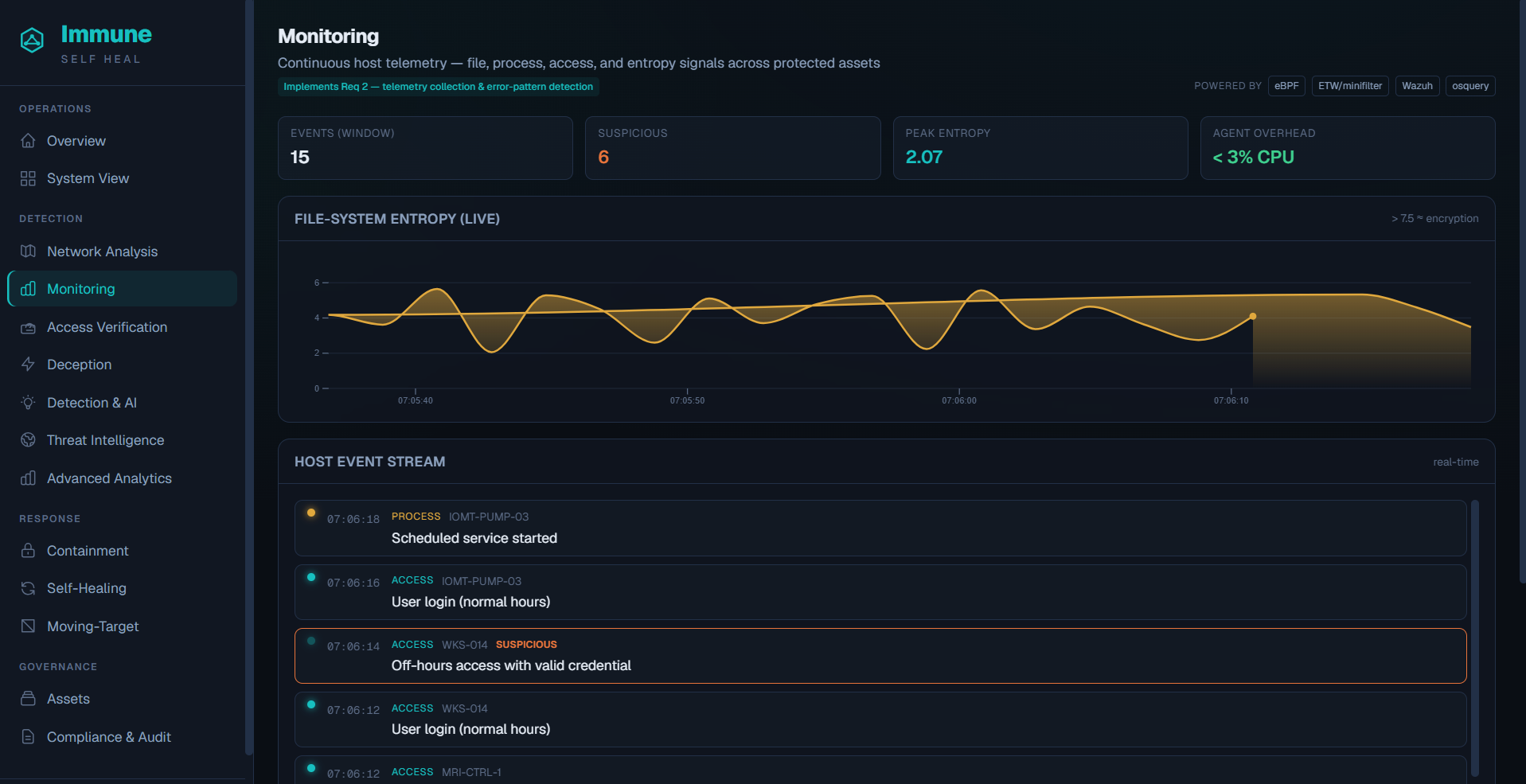
New Jersey's risk looks different in a pharma lab, a hospital, a bank, and a county office. Here is how we tailor detection, containment, and recovery to each, shown in the Immune console.
Pharmaceutical & life sciences
New Jersey's 'medicine chest' is a target unlike any other state's. Attackers come for proprietary research, clinical-trial datasets, and manufacturing IP that can represent a decade of work, and they can jump from IT into the operational technology that runs physical production. We watch for the abnormal data flows that precede research theft and protect the IT/OT boundary so an attack cannot quietly exfiltrate a pipeline's worth of data or stop the line.
- Detect exfiltration of research and trial data before it completes
- Protect the IT/OT boundary on regulated manufacturing systems
- Immutable audit for regulators, partners, and litigation
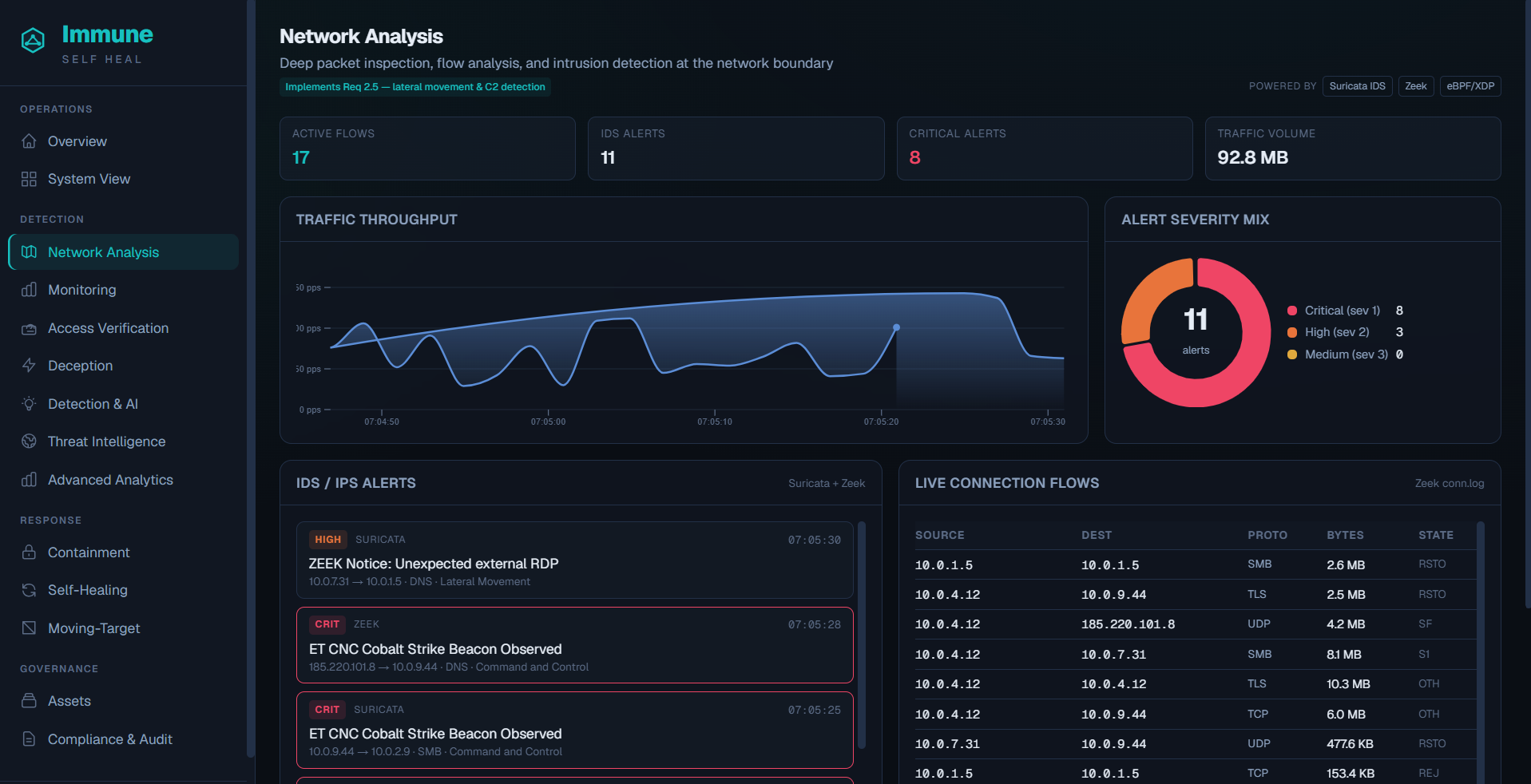
Hospitals & health systems
From Capital Health to the Ardent-run Mountainside and Pascack Valley hospitals, New Jersey healthcare has absorbed repeated, public hits. A large NJ hospital runs ten to fifteen thousand connected devices that cannot host a security agent, and that is exactly where attackers hide. We defend those devices at the network boundary and restore clinical systems in care-priority order when something gets through.
- Agentless coverage for infusion pumps, imaging, and monitors
- Care-aware containment gated behind one-click approval
- EHR-first, validated recovery measured in hours
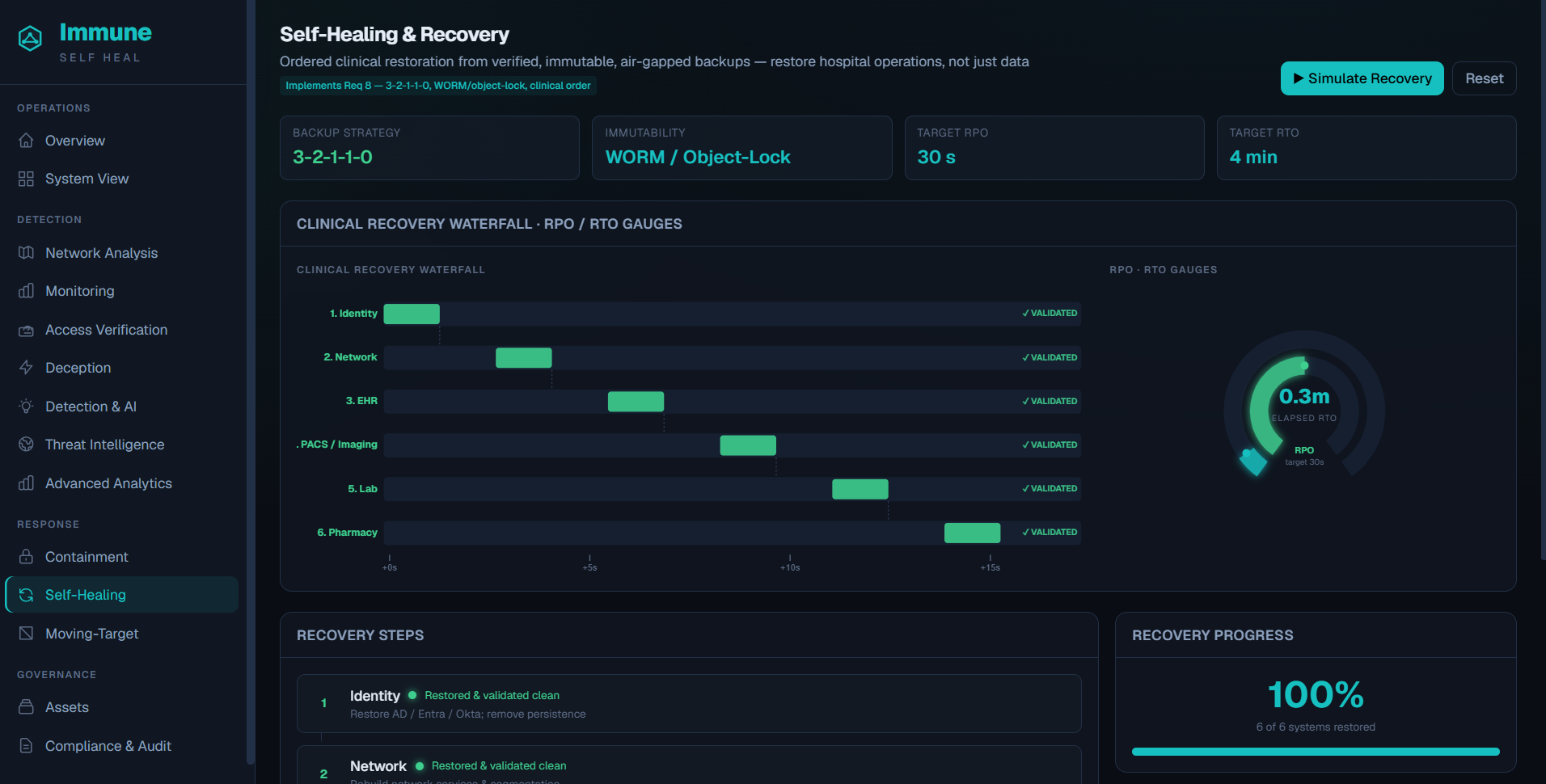
Financial services
Major banks, insurers, and asset managers run back-office and data-center operations inside New Jersey, so the systems that clear transactions and hold customer records sit in the state. We score every internal access continuously, so a credential behaving abnormally is caught even when the login itself looks legitimate, and we keep the immutable audit trail regulators expect.
- Continuous verification of every internal access
- Transaction-system protection and fast validated recovery
- Tamper-proof audit for regulatory reporting
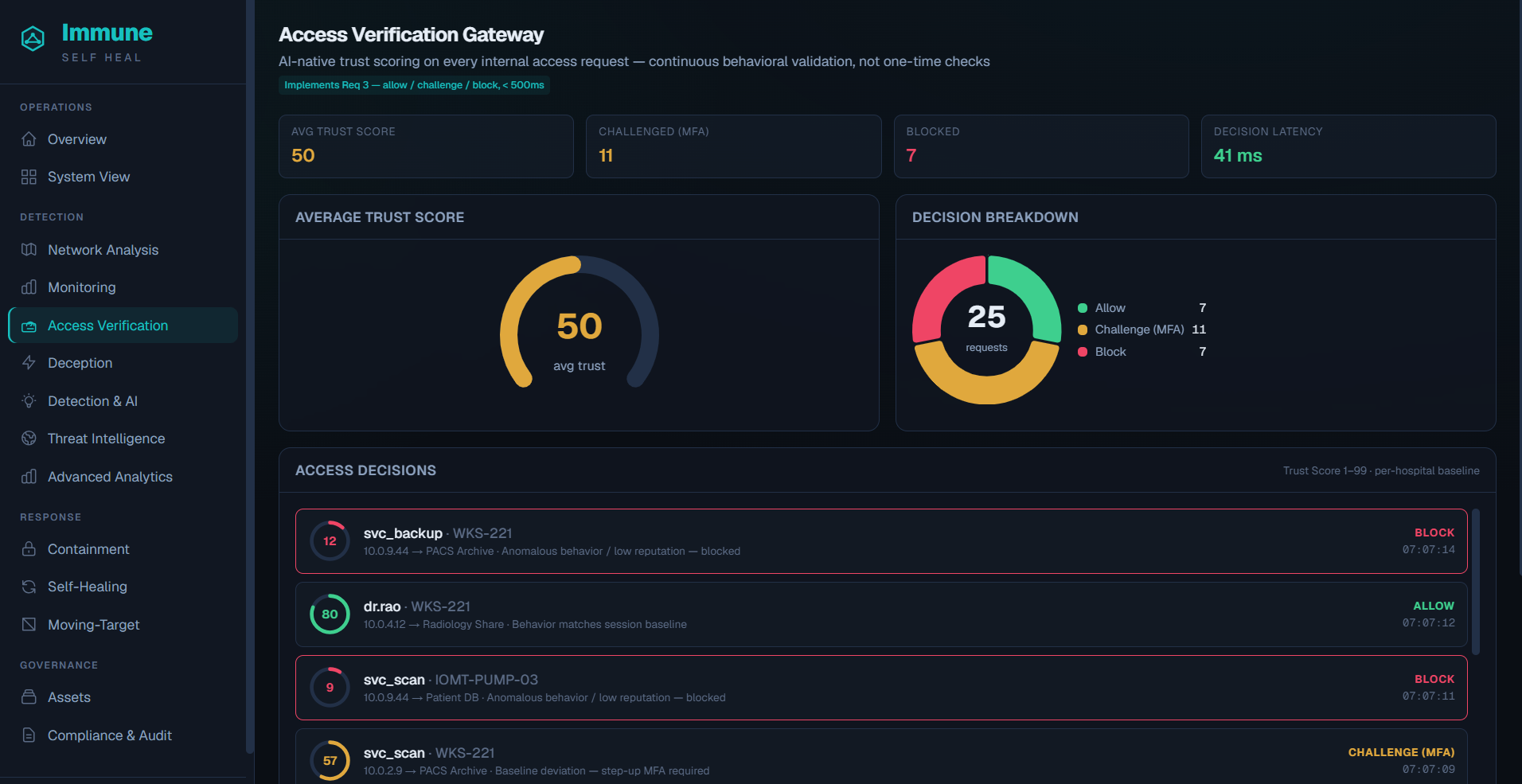
Government, education & critical infrastructure
Passaic County, the Union and Bayonne school districts, New Jersey City University, and American Water all show how far the threat reaches beyond healthcare. These are lean-IT organizations running essential services for residents. We give them enterprise-grade detection, automated containment, and independent recovery without needing a large in-house security team.
- Keep citizen and student services running through an attack
- Automated containment for lean IT teams
- Recover without paying, aligned to NJ mandatory-reporting rules
By industry
Ransomware protection for New Jersey's key industries
Immune tailors ransomware protection to the sectors that define New Jersey. Explore how we protect each.
Coverage
Ransomware protection software for organizations across New Jersey
As a ransomware protection solution for New Jersey, Immune delivers anti-ransomware detection, containment, and ransomware recovery for healthcare providers and organizations across New Jersey, including Newark, Jersey City, Trenton, Paterson, and Edison. Whether you need ransomware protection software for a hospital, a manufacturer, or a government agency in New Jersey, Immune is built to keep operations running through an attack.
Immune is an independent security platform and is not affiliated with or endorsed by the organizations listed. Names indicate the New Jersey providers our platform is designed to protect.
Common questions
Ransomware protection in New Jersey, answered
+Why is New Jersey such a major ransomware target?
New Jersey packs an unusual amount of high-value, attackable data into a small, tightly connected footprint. It is a global pharmaceutical and life-sciences hub, a major financial-services corridor in the New York metro, and a dense healthcare market serving nine million residents. The $4.5 million Capital Health settlement, which grew out of a LockBit attack that exposed more than 500,000 people and caused a two-week outage, shows how high the stakes already are.
+What was the Capital Health ransomware attack?
In November 2023 the LockBit ransomware group attacked Capital Health, a New Jersey health system with facilities in Trenton and Hopewell. The attack caused an IT outage from November 11 to 26 that disrupted surgeries and diagnostic testing and exposed the data of more than 500,000 people. LockBit claimed it stole over seven terabytes of data. The class-action litigation that followed settled for $4.5 million and received final court approval in July 2026.
+Does Immune support New Jersey breach-notification requirements?
Yes. New Jersey law (N.J.S.A. 56:8-163) requires timely notification of breaches involving personal information. Our immutable, hash-chained audit logging and clear incident records give you the evidence you need to make breach determinations, meet your notification obligations, and defend your response if someone challenges it later.
+Can Immune protect New Jersey hospitals?
Yes. We protect New Jersey health systems with detection, containment, and self-healing recovery, and that includes agentless coverage for the connected medical devices endpoint tools cannot reach. Given the Capital Health attack and the device-heavy environment every NJ hospital runs, that coverage matters directly.
+How fast can Immune recover a New Jersey organization after an attack?
We restore affected systems from verified, immutable, air-gapped backups in priority order, checking each one is clean before it goes back into service. The aim is a controlled recovery measured in hours rather than the weeks a manual rebuild can take. Capital Health's two-week outage is the difference that makes.
+Can Immune protect New Jersey pharmaceutical and life-sciences companies?
Yes. Our network-level detection surfaces the abnormal data flows that come before theft of proprietary research and clinical-trial data, and our IT/OT-boundary protection defends the manufacturing systems drug producers run. An attack can neither quietly exfiltrate research nor halt physical production. Given the state's life-sciences dominance, this is a New Jersey-specific priority.
+How does Immune limit spread across New Jersey's interconnected systems?
Our automatic containment and microsegmentation isolate a threat in seconds and limit how far an intrusion can travel across the tightly connected healthcare, pharma, financial, and government systems packed into New Jersey. We also verify internal access continuously, so we catch the credential-based, malware-free intrusions that now dominate and that traditional endpoint tools miss.
+Does ransomware protection in New Jersey only matter for healthcare?
No. Healthcare has seen the most severe public incidents, but the state's exposure runs across pharmaceutical manufacturing, financial services, and government. The Passaic County attack shows county and municipal bodies get targeted too. We protect organizations in all of these sectors and tailor detection, containment, and recovery to the systems each one depends on.
Other states
Ransomware protection in other states
Immune protects healthcare providers and organizations nationwide. Explore ransomware protection in other states.
Explore the platform
Related capabilities
References
Sources and further reading
Every incident and figure on this page is drawn from public reporting. The primary sources are listed below.
- 1.BankInfoSecurity: Capital Health to Pay $4.5M in LockBit Breach Settlement
- 2.HIPAA Journal: Capital Health Data Breach Litigation Settled for $4.5M
- 3.NorthJersey.com: Two NJ hospitals continue to divert patients after cyberattack (Ardent)
- 4.CyberScoop: Hackensack Meridian Health pays attackers to thwart ransomware incident
- 5.NJCCIC: Central Jersey Medical Center data breach notice
- 6.Comparitech: LockBit claims cyber attack on Union, NJ schools
- 7.NJCCIC: 2024 Key Cybersecurity Takeaways (American Water)
- 8.U.S. DOJ, District of New Jersey: LockBit enforcement
- 9.GovTech: New Jersey Sign-Ups for MS-ISAC (statewide membership)
Last reviewed and updated on September 8, 2026. Incident figures are drawn from public reporting and are cited on this page.
Keep your New Jersey operation running through ransomware
See how Immune detects, contains, and self-heals critical systems for organizations across New Jersey.